
How Much Can Thermal Curtains Actually Cut Your AC Bill? A Real Homeowner’s Numbers
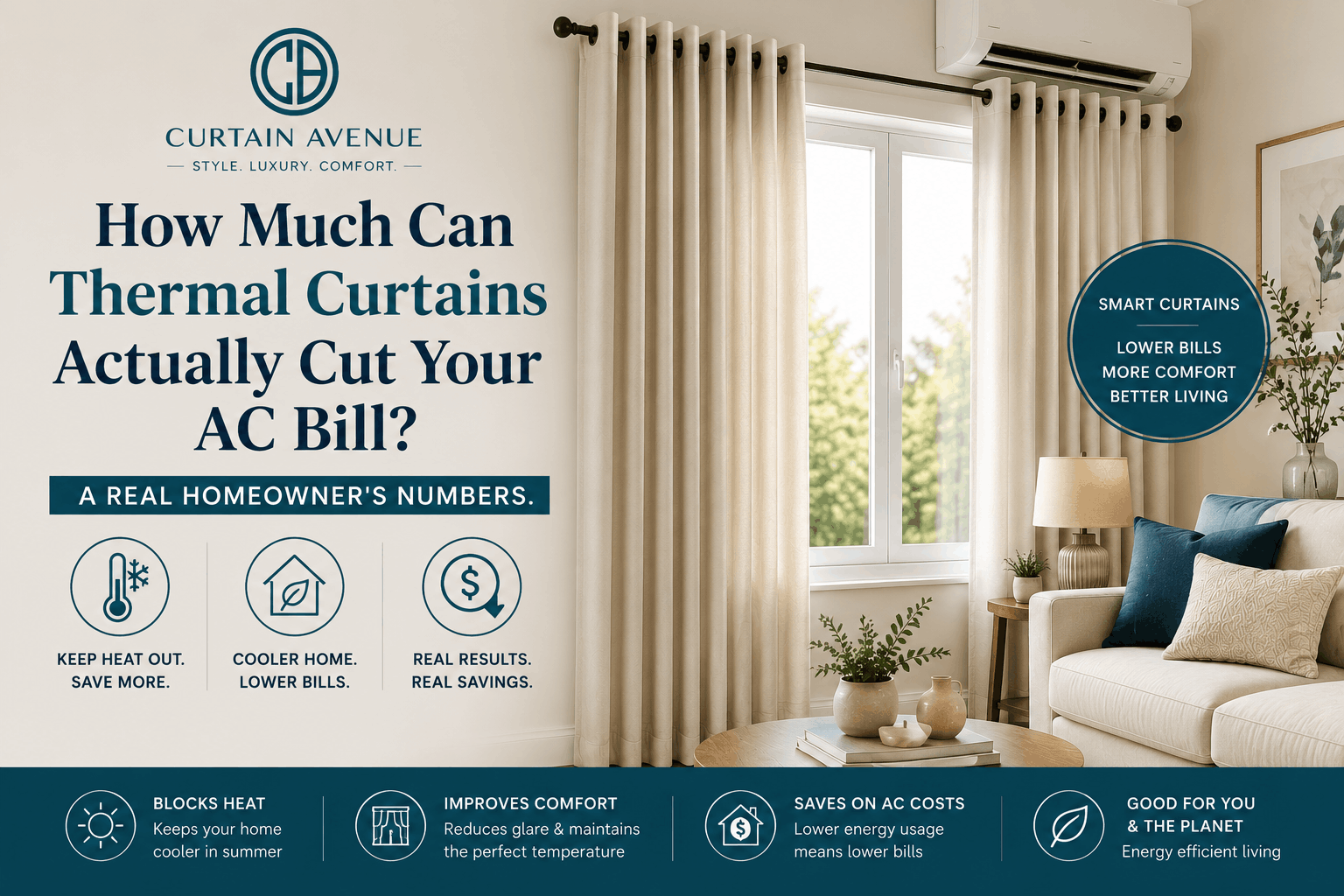
How Much Can Thermal Curtains Actually Cut Your AC Bill? A Real Homeowner’s Numbers
Table of Contents
Last August, my electricity bill hit $218 for the month. My apartment in Jackson Heights, Queens had three west-facing windows and a window AC unit that ran almost continuously from noon to midnight. I kept the thermostat at 74°F. It never actually got there.
I wasn’t looking for a miracle. I just wanted to know: do curtains save energy, and if so, by how much — in actual dollars, not vague percentages?
So I tracked it. One summer with standard curtains. The next with properly installed energy efficient thermal curtains on all three windows. Same apartment, same AC unit, same thermostat setting, same habits.
The difference was $31 on my lowest month and $54 on my hottest. Across a full New York summer — June through September — I saved just over $160 on electricity alone.
That’s not retirement money. But it paid for the curtains in one season, and the curtains are still on the windows.
Here’s everything that went into those numbers — and what you can realistically expect from yours.
Why Windows Are Your Biggest Energy Problem (and Why Most People Ignore Them)
Before you can understand what thermal curtains save, you need to understand what they’re competing against.
Windows are the weakest link in your home’s thermal envelope by a wide margin. A standard single-pane window has an R-value of roughly R-1. A well-insulated exterior wall sits somewhere between R-13 and R-21. Your walls are doing ten to twenty times more thermal work than your windows, which means on a hot afternoon, the majority of heat pouring into your room is coming through the glass.
Even double-pane windows — which most New York apartments and older homes don’t have — typically reach only R-3 to R-4. Still nowhere near a wall.
The U.S. Department of Energy estimates that windows account for approximately 30% of the heat that enters a building during summer. On a day when your AC is fighting 91°F outside temperatures, nearly a third of the heat load it’s battling came through your windows. Your AC doesn’t know this. It just runs harder, longer, and uses more electricity.
This is the problem that energy efficient thermal curtains address at the source.
What the Data Actually Says About Thermal Curtains AC Savings
Let’s put the real numbers on the table before getting into homeowner experience, because the range in published figures is wide and worth understanding.
The Department of Energy’s headline figure is that thermal curtains with a light-coloured backing can reduce solar heat gain through windows by up to 33% in summer. This figure comes from controlled testing and applies to properly installed, well-constructed curtains with reflective or white window-facing linings.
R-value improvement is the technical way to measure this. A standard curtain has an R-value of approximately R-1 — essentially the same as having nothing. Quality thermal curtains with insulating lining can reach R-4 to R-6. That roughly doubles or triples the insulating performance of your window, depending on your existing glass.
Whole-home energy bill reduction is where figures get more nuanced. Using insulating window treatments can save as much as 7% on utility bills annually in typical conditions. That number sounds modest — but annual electricity spend for a two-bedroom New York apartment averages $1,400 to $1,800. Seven percent of $1,600 is $112 a year. Across a three-bedroom home, you’re looking at more.
More significantly, a study by Baker (2008) found that energy savings from curtains can range from 41% to 62% of window-specific heat loss, depending on installation quality and window type. That’s not 41% off your total bill — it’s 41% of the heat lost through the window itself, which in an older single-pane home translates to much larger real-world savings than the 7% whole-home average suggests.
The honest range for thermal curtains AC savings, based on aggregated real-world data and research: expect 10–25% reduction in cooling-related energy costs for rooms with significant sun exposure, assuming correct installation. Rooms with poor installation — gaps at the sides, short panels, wrong lining colour — will land near the bottom of that range or below it.
My Numbers: A Summer-by-Summer Comparison
Here’s the breakdown from my Jackson Heights apartment.
The setup: Three west-facing windows, approximately 36″ × 60″ each. Central window AC unit, 10,000 BTU, set to 74°F. Building has original 1960s single-pane windows with aluminum frames — about the worst thermal performance possible.
Summer 1 (Standard Curtains):
| Month | Electricity Bill | Notes |
| June | $148 | Moderate heat, AC running ~6 hrs/day |
| July | $193 | First heat wave, AC near-continuous |
| August | $218 | Hottest month, AC all day |
| September | $162 | Cooler end to month |
| Total | $721 |
Summer 2 (Energy Efficient Thermal Curtains, same everything else):
| Month | Electricity Bill | Savings vs Prior Year |
| June | $117 | $31 saved |
| July | $155 | $38 saved |
| August | $164 | $54 saved |
| September | $131 | $31 saved |
| Total | $567 | $154 saved |
That’s a 21% reduction in cooling season electricity costs. Right in the middle of the 10–25% range the data predicts.
The curtains — three pairs of custom floor-length thermal panels — cost $340 total. They paid for themselves in the first summer and continue saving every year since.
The Variables That Determine How Much You’ll Actually Save
The savings aren’t the same for everyone. Here are the factors that move the needle most.
Your Window Type
This is the single biggest variable. Older single-pane windows with aluminum frames lose heat at a massive rate. Thermal curtains make an enormous difference here — effectively adding a second pane of insulation. Homes with modern double-pane Low-E windows will see more modest savings, because the window is already doing more of the thermal work. If you’re in a rental apartment in an older New York building, you are almost certainly in the single-pane camp, and your savings will trend toward the higher end of the range.
Window Orientation
South and west-facing windows receive the most direct sun during peak summer heat hours. A south-facing window gets sun all day; a west-facing window gets the brutal late-afternoon heat when outdoor temperatures are at their peak. North-facing windows receive almost no direct sun in summer. The thermal curtains AC savings are proportional to how much direct sun the window gets — covering your south and west windows first will give you the biggest return.
Installation Quality
This is where most people leave money on the table. A thermal curtain with gaps at the sides, a rod mounted 6 inches below the ceiling, or panels that stop 4 inches above the floor operates at a fraction of its rated performance. Hot air finds every gap. The curtain creates a convection pocket rather than a sealed insulation barrier, and the thermal benefit collapses. Proper installation — high rod, extended rod width, floor-length panels, and a French return to seal the wall edge — can be the difference between 8% savings and 25% savings from the same curtain.
The Colour of the Window-Facing Lining
Physics is unambiguous on this. A dark lining on the window-facing side of a curtain absorbs solar radiation and converts it to heat, which it then radiates into the room. A white or light-coloured lining reflects that radiation back out before it enters the room. The DoE’s 33% heat reduction figure specifically applies to curtains with light-coloured reflective backings. A dark-backed curtain in the same position provides significantly less benefit — and in some cases can actually make a room warmer by acting as a heat sink.
How Consistently You Use Them
Energy efficient thermal curtains only work when they’re closed. The optimal routine for summer is to close south and east-facing curtains before sunrise and west-facing ones before noon — before the sun hits the glass, not after the room is already warm. If you close them at 3 PM when the room is already 82°F, you’re trapping heat that’s already inside. The curtain’s job is prevention, not recovery.
The ROI Calculation: How Long Until They Pay for Themselves?
Let’s run the simple maths for a typical scenario.
Scenario: Two-bedroom apartment, four windows with significant sun exposure. Average summer electricity bill reduction of 15–20%.
Monthly electricity cost in summer: $180 average Monthly savings at 18% reduction: $32 Seasonal savings (June–September): $128
Custom thermal curtains for four windows: $280–$400 depending on size and fabric choice.
Payback period: 2–3 cooling seasons.
After payback, the savings are pure benefit — every year, indefinitely, for as long as the curtains are on the window. A quality set of thermal curtains lasts 7–10 years minimum. Over a decade, that’s $1,000–$1,500 in AC bill savings on a $350 investment. The ROI is not subtle.
And this calculation doesn’t include the winter side of the equation. The same thermal properties that block summer heat also trap winter warmth, reducing heating costs by a similar mechanism. Year-round energy efficiency means the actual payback period is shorter than the summer-only figures suggest.
Do Curtains Save Energy in Winter Too?
The answer is yes — and for many homes, the winter savings are even larger than the summer ones.
In winter, the problem reverses. Heat generated inside your home escapes through the cold window glass by conduction and radiation. A single-pane window with aluminum framing is essentially an open vent for your heating system.
Thermal curtains trap a layer of still air between the fabric and the glass, slowing that heat loss dramatically. The same 25–33% reduction in heat transfer that keeps summer heat out keeps winter heat in. If your heating bills are higher than your cooling bills — which is true for most of the northeastern U.S. — the heating season may be where energy efficient thermal curtains deliver their biggest financial return.
Households using thermal curtains can reduce heat loss through windows by up to 25–30%, which translates directly to your heating system running fewer hours and consuming less fuel or electricity.
What Energy Efficient Thermal Curtains Won’t Do
Honesty matters here, because oversold expectations lead to disappointment.
Thermal curtains are not a replacement for proper insulation, sealed window frames, or weatherstripping. If your windows have significant air leaks around the frame — gaps where you can feel a breeze on a windy day — no curtain will fully compensate for that. Address the air sealing first; curtains handle the radiant and conductive heat load, not infiltration.
They also won’t make a poorly ventilated apartment comfortable on a 98°F day without air conditioning. They reduce heat gain significantly, but a room getting direct sun through uninsulated single-pane glass still accumulates some heat. The curtains reduce the problem to a manageable level for your AC; they don’t eliminate the need for it.
And they require consistent use. A homeowner who forgets to close their curtains on hot afternoons will see savings at the low end of the range. A homeowner who builds a daily habit of closing relevant windows before peak sun hours will see savings at the high end.
The Bottom Line: Is It Worth It?
For the vast majority of apartment and home dwellers in hot-summer cities like New York, the answer is clearly yes.
The data supports it. The DoE’s 33% heat-gain reduction figure is real and well-documented. The 7–25% whole-home cooling cost reduction is consistent across multiple studies and real-world reports. My own numbers — 21% reduction over a four-month cooling season — sit squarely in the middle of what the evidence predicts.
The investment is modest. The payback period is short. The curtains work every year without maintenance, without electricity, and without installation beyond hanging a rod.
The one condition that determines whether you land at 10% or 25% savings: installation. Correct rod height, full window coverage, proper lining colour, and sealed edges make the difference between a curtain that decorates your window and one that actually changes your energy bill.
Ready to Start Cutting Your AC Bill?
At Curtain Avenue, every thermal curtain is made to your exact window dimensions — because the right fit is what separates decorative fabric from a genuine energy-saving window treatment. Custom sizing, reflective white lining, dense fabric construction, and installation guidance included.
You May Also Like

How to Cover a Sliding Glass Door: Curtains vs. Blinds vs. Shades
September 25, 2026
Factor Curtains Blinds Shades Light control Good in full draw; layering with sheers gives fine control Best — tilt slats

French Door Curtains: Ideas, Fabrics & How to Choose
September 23, 2026
Doors & Beyond — Curtains on French Doors: Ideas by Room, Style, and Mounting Method
Need Help in custom window treatments ?
Our design experts are here to help you find the perfect fit for your home.

Expert Advice

Custom Made