
How to Measure and Choose Custom Roman Shades: The Complete Guide
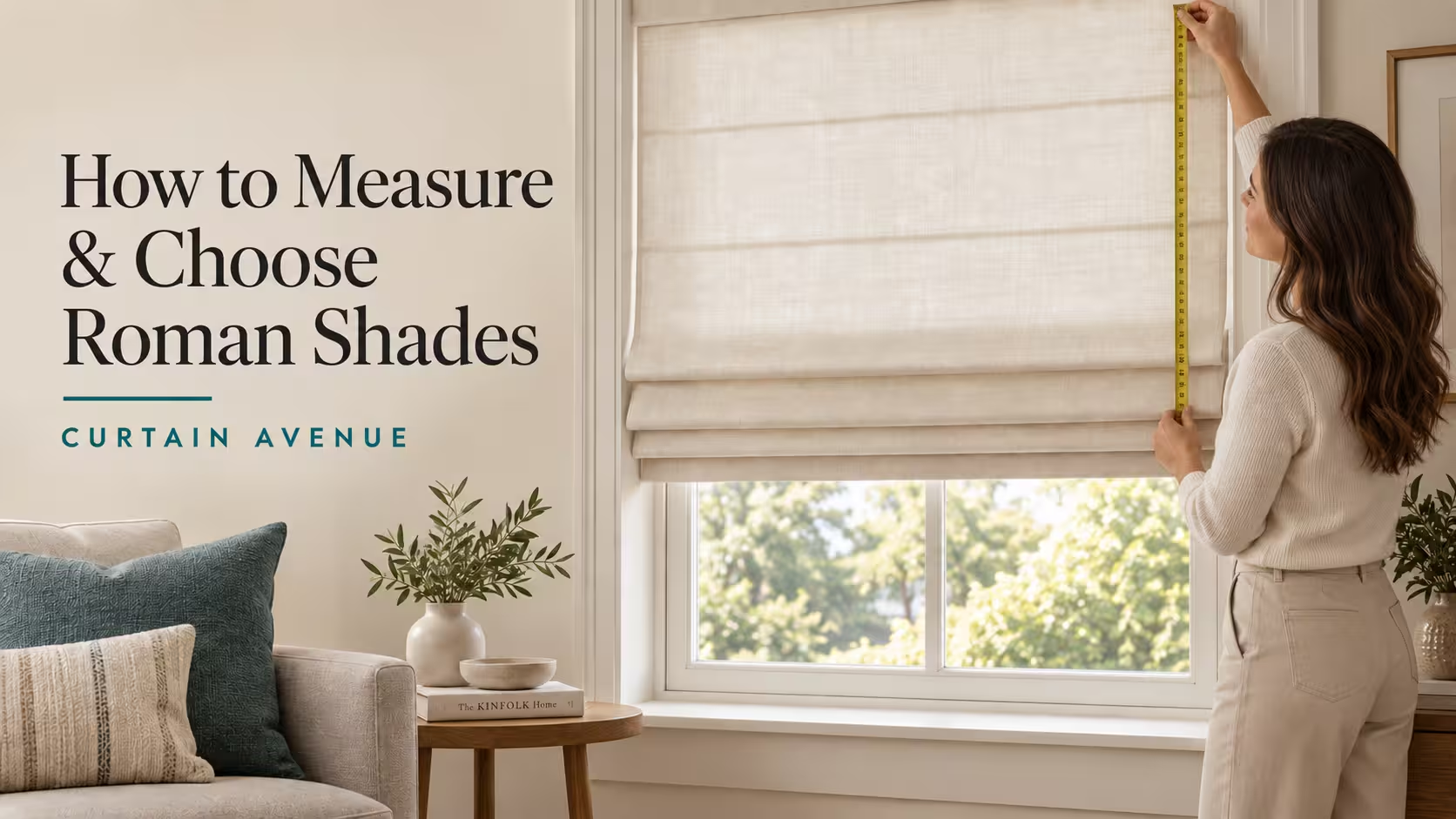
How to Measure and Choose Custom Roman Shades: The Complete Guide
Table of Contents
To measure for roman shades, first decide whether you want an inside mount (fitted inside the window frame) or an outside mount (mounted on the wall or trim outside the frame) — the two use different measuring rules and different amounts of fabric. Inside mount uses your narrowest width measurement minus about ¼ inch for clearance; outside mount adds roughly 1.5–2 inches of fabric coverage on each side of the frame. From there, your choice of fabric — sheer, patterned, or a heavier custom fabric roman shade — and mounting hardware finish the job.
This guide walks through both measuring methods step by step, then covers how to pick the right fabric, mount, and hardware so your custom roman shades fit and function the way you expect the first time.
What You’ll Need to Measure a Window for Roman Shades
You only need three things: a steel tape measure (a fabric or cloth tape can stretch and throw off your numbers by a fraction of an inch, which matters at this scale), a pencil and paper or your phone’s notes app, and a step stool for anything above shoulder height. Measure in inches to the nearest 1/8 inch, since most manufacturers — Curtain Avenue included — order and cut to that level of precision.
Inside Mount vs. Outside Mount Roman Shades: Which Should You Choose?
Inside mount roman shades sit flush within the window frame for a clean, built-in look, while outside mount roman shades attach to the wall or trim above and around the frame, making the window appear larger and fully hiding the glass when closed. Choose inside mount when your window has at least 1.5 inches of flat, unobstructed depth and you want the shade to sit neatly inside the frame. Choose outside mount when the frame is too shallow, when there’s a window crank or handle in the way, or when you want to visually enlarge a small window.
Minimum mounting depth for an inside mount varies by manufacturer and lift style — most custom roman shades need somewhere between 1 and 3.5 inches of flat, unobstructed frame depth, with lined or hobbled-fold shades typically needing more than a simple flat-fold shade. If your window has less depth than your chosen shade requires, or anything protruding into that space, outside mount is the better — sometimes the only — option.
How to Measure for Inside-Mount Roman Shades
- Measure the width at three points — the top, middle, and bottom of the window opening — and use the narrowest of the three measurements. Window openings are rarely perfectly square, so using the narrowest number prevents ordering a shade that’s too wide to fit.
- Subtract about ¼ inch from that narrowest width measurement to allow the shade to raise and lower smoothly without rubbing against the frame.
- Measure the height at three points — left, center, and right — and use the longest of the three measurements, so the shade fully covers the opening at every point.
- Check for obstructions inside the frame, such as a crank handle, lock, or uneven trim. If anything blocks the shade’s path, switch to an outside mount instead.
- Confirm your manufacturer’s deduction policy before ordering, and don’t deduct on your own unless asked to. Most custom shade companies apply the ¼-inch (or similar) operating clearance on their end once you submit your exact frame measurement — deducting it yourself as well is one of the most common causes of an undersized, poor-fitting shade. Only subtract the clearance yourself if the manufacturer’s instructions explicitly tell you to.
- For a bay window, an angled frame, or anything not a standard rectangle, measure and order each pane as its own separate window rather than trying to average the angles into one shade — a roman shade is a flat panel and can’t compensate for a non-rectangular opening the way some folding shade styles can.
How to Measure for Outside-Mount Roman Shades
- Measure the width of the window frame itself, then add approximately 1.5–2 inches on each side (3–4 inches total) so the shade fully covers the frame and blocks light gaps at the edges.
- Decide how high above the frame to mount the bracket. Two to six inches above the top of the window frame is the typical range across manufacturers; mounting higher within that range makes the window look taller and can clear a handle or trim that would otherwise interfere.
- Measure the height from your chosen bracket position down to the sill, or a few inches past the sill if you want extra coverage for light blocking or privacy.
- No minimum depth is required for outside mount, since the shade attaches directly to the wall or trim rather than fitting inside the frame — this makes it the reliable fallback whenever an inside mount won’t work.
- For multiple windows in the same room, measure each one individually but order using the largest height measurement across the group, so the shades’ pleats and folds line up visually when viewed together.
Roman Shade Fabric Options: Sheer, Patterned, and Custom
The fabric you choose changes how much light a roman shade lets in and how it looks both raised and lowered, so it’s worth deciding on function before pattern.
Sheer roman shades filter daylight and diffuse it softly into the room without blocking the view entirely, which makes them a common choice for living rooms and dining spaces where you want light but not full privacy. Patterned roman shades work well as a room’s focal point — a bold botanical, geometric, or solid jewel-tone fabric on a roman shade reads as more tailored than the same pattern on a full curtain panel, because the folds stay controlled rather than draping loosely. For rooms that need more light control, ask about a blackout or light-filtering lining behind your chosen face fabric — this keeps your pattern or color on the outside while controlling how much daylight comes through.
Because custom fabric roman shades are made to your exact width and height, the fabric is cut and seamed specifically for your window rather than trimmed down from a stock size — worth confirming with any manufacturer you’re comparing, since stock shades can show visible seams or an off-center pattern repeat that custom fabrication avoids.
Choosing the Right Mount Hardware and Brackets
Roman shade brackets come in two basic types: inside-mount brackets, which sit inside the frame depth and attach to the top or side jambs, and outside-mount brackets, which attach to the wall or trim face above the window. The bracket type has to match how you measured — an inside-mount bracket can’t be retrofitted to an outside-mount shade and vice versa, so confirm your mount style before ordering hardware.
Exterior (outside) mount roman shades are also the right call for windows with an unusually shallow frame, a radiator or deep sill just below the window, or a window seat where you don’t want fabric interfering with the seat cushion below.
Can You Sew Your Own Roman Shades?
Yes — a basic flat or relaxed roman shade is a manageable sewing project if you already have some experience with a sewing machine, mounting board, and shade tape or rings and cord to create the fold lines. The tradeoff is precision: a sewn shade’s fold spacing has to be calculated and stitched by hand, and any error in the width or height math shows up as an uneven fold every time you raise it. For that reason, DIY roman shades tend to work best as a first project for a small or low-stakes window, while a bay window, an oversized picture window, or any room where an off pattern-match would be obvious usually gets a better result from a custom-made shade with machine-precise fold spacing.
Roman Shades for Bathrooms and Other Humid Rooms
Roman shades can work well in bathrooms, but the fabric and lining matter more there than in any other room. Look for a moisture-resistant or easy-clean face fabric, and avoid natural fibers like unlined linen or silk that can water-spot or mildew near a shower or bathtub. A shade mounted with at least a few inches of clearance from the tub or sink, paired with a wipeable or synthetic-blend fabric, holds up best in a bathroom’s humidity over time.
Inside Mount vs. Outside Mount: Quick Comparison
| Factor | Inside Mount | Outside Mount |
|---|---|---|
| Look | Clean, built into the frame | Makes window appear larger |
| Minimum depth needed | 1.5 inches of flat frame depth | None — mounts to wall or trim |
| Width measurement | Narrowest of 3 points, minus ¼” | Frame width plus 1.5–2″ per side |
| Best for | Windows with clear, unobstructed frame depth | Shallow frames, handles/cranks, small windows you want to enlarge |
| Light gaps at edges | Minimal, since shade sits inside frame | Can occur if shade doesn’t extend far enough past frame |
Frequently Asked Questions
How much fabric do I need for a custom roman shade?
It depends on your finished width and height and whether you choose a flat, relaxed, or hobbled (structured-fold) style, since each fold style uses a different amount of fabric per finished inch. A manufacturer building to your exact measurements will calculate this for you — that’s one advantage of ordering custom rather than estimating fabric for a DIY project yourself.
Can roman shades be mounted outside the window frame?
Yes. Outside-mount roman shades attach to the wall or trim surrounding the window rather than inside the frame, and they’re the standard choice whenever a window’s frame is too shallow, has a handle or crank in the way, or when you want the finished window to look larger than its actual opening.
What’s the best fabric for roman shades in a bathroom?
A moisture-resistant, easy-clean synthetic or synthetic-blend fabric holds up best in a bathroom’s humidity. Avoid unlined natural fibers like linen or silk near a tub or shower, since they’re more prone to water spotting and mildew over time.
How do I measure a window that isn’t perfectly square?
Measure width and height at three points each — top, middle, and bottom for width; left, center, and right for height — then use the narrowest width and the longest height for an inside mount. This ensures the shade both fits inside the frame and fully covers the opening, even if the window itself is slightly out of square.
Do I need special brackets for an exterior mount roman shade?
Yes. Outside-mount roman shades use brackets designed to attach to a wall or trim surface rather than the inside of a window frame, and the two bracket types aren’t interchangeable — confirm your mount style before your hardware ships.
The Bottom Line
Getting a custom roman shade right starts with one decision — inside or outside mount — because it determines how you measure, how much fabric you’ll need, and which hardware you’ll use. From there, matching your fabric (sheer, patterned, or lined for light control) to the room does most of the remaining work. When your window’s frame is shallow, obstructed, or unusually shaped, outside mount is almost always the more forgiving choice, while a clean, deep frame is a good candidate for the tailored look of an inside mount.
Ready to get exact measurements for your own windows? Start your custom Roman shades quote and enter your measurements to see fabric and mounting options side by side.
You May Also Like
How to Cover a Sliding Glass Door: Curtains vs. Blinds vs. Shades
September 25, 2026
Factor Curtains Blinds Shades Light control Good in full draw; layering with sheers gives fine control Best — tilt slats
French Door Curtains: Ideas, Fabrics & How to Choose
September 23, 2026
Doors & Beyond — Curtains on French Doors: Ideas by Room, Style, and Mounting Method
Need Help in custom window treatments ?
Our design experts are here to help you find the perfect fit for your home.

Expert Advice

Custom Made