

Blog
Last July, I moved my work desk closer to the window in my apartment in Queens, New York. It felt like a good idea at the time. Natural light, a bit of greenery outside, and a nice open view.
That lasted exactly three days.
By noon, the sunlight hitting my desk was so harsh that I couldn’t see my laptop screen properly. The surface got warm, the room felt stuffy, and I started pulling random fabrics over the window just to make it bearable.
That was my introduction to figuring out what actually works when it comes to sun blocking curtains.
Because here’s the truth: not all curtains block sunlight the same way. Some reduce glare. Some reduce heat. Some protect against UV. And very few actually do all three well.
If you’re trying to figure out which curtains to block sunlight actually make a difference, this guide will walk you through it without the fluff.
What Do Sun Blocking Curtains Actually Do?
Let’s start with what they’re meant to solve.
When sunlight enters your room, it brings three things with it:
- Brightness (which causes glare)
- Heat (which warms up your space)
- UV rays (which fade furniture and damage surfaces)
Good sunlight blocking curtains address at least one of these. Better ones handle all three.
But the level of effectiveness depends entirely on the fabric, layering, and how the curtain is made.
How Much Heat Do Sun Blocking Curtains Reduce?
This is usually the first concern.
In my case, sitting near a sunlit window in Queens meant the temperature around my desk felt noticeably higher than the rest of the room.
After switching to proper sun blocking curtains, the difference wasn’t dramatic like switching on an AC, but it was clear.
The space near the window felt less intense. The heat buildup slowed down. The room stayed more consistent.
On Average
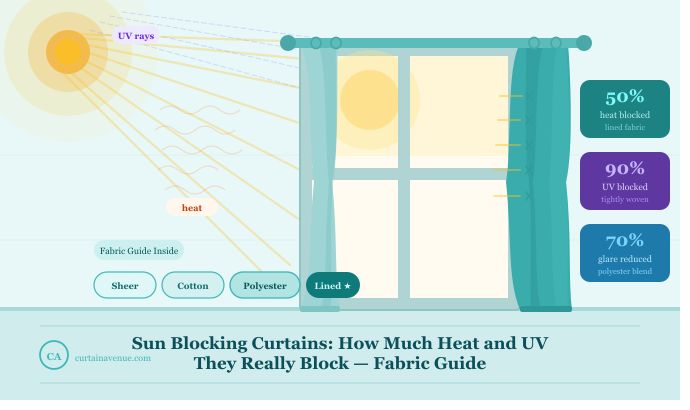
Well-constructed sun blocking curtains can reduce heat gain by:
- 20 to 40 percent with standard fabrics
- Up to 50 percent with thicker or lined curtains
This depends heavily on the material.
Thin cotton curtains? Minimal impact.
Dense polyester with lining? Noticeable difference.
What About UV Protection?
This is the part most people ignore until it’s too late.
UV rays don’t just affect your skin. They slowly damage:
- Wooden furniture
- Upholstery
- Flooring
- Artwork
If you’ve ever noticed fading on a couch or discoloration on a table near a window, that’s UV damage.
How Much UV Do Curtains Block?
- Light fabrics: 10 to 30 percent
- Medium density fabrics: 50 to 70 percent
- Lined or tightly woven fabrics: up to 90 percent or more
This is where UV blocking curtains become important, especially in rooms with direct sunlight exposure.
Not All Curtains Are Equal (Fabric Guide That Actually Helps)
Let’s break this down in a way that actually helps you choose.
1. Sheer Curtains
These are the most common and the most misunderstood.
They look great. They soften light beautifully. But when it comes to blocking sunlight?
They do very little.
- Heat reduction: very low
- UV protection: minimal
- Light blocking: almost none
Best used for aesthetics, not function.
Recommended products
2. Cotton Curtains
A step up, but still limited.
Cotton can reduce some glare and slightly soften sunlight, but it is not designed for serious heat or UV control.
- Heat reduction: low
- UV protection: moderate (depending on thickness)
- Light blocking: partial
Good for mild sunlight, not strong exposure.
3. Polyester Curtains
This is where things start getting practical.
Most effective sun blocking curtains today are made with polyester or polyester blends.
Why?
Because polyester can be:
- Woven tightly
- Layered easily
- Combined with thermal or blackout linings
- Heat reduction: moderate to high
- UV protection: good
- Light blocking: adjustable (based on layering)
This is the fabric used in many functional designs, including custom curtains available at Curtain Avenue.
4. Lined Curtains (Game Changer)
If there’s one thing that makes the biggest difference, it’s lining.
A curtain with a proper lining instantly becomes more effective.
- Reflects sunlight
- Adds insulation
- Improves UV protection
This is where sunlight blocking curtains start performing like a real solution instead of just a visual filter.
Real-Life Setup That Actually Works
After trying different combinations, here’s what worked best in my apartment.
- A dense polyester curtain with a light thermal lining
- Full window coverage (no gaps)
- Floor-length installation
The result:
- Reduced glare on my screen
- Noticeably less heat near the window
- No more direct sunlight hitting surfaces
It didn’t make the room dark. It made it comfortable.
Curtains to Block Sunlight vs Blackout Curtains
This is where confusion usually happens.
People often assume blackout curtains are the only solution.
But that depends on what you want.
Sun Blocking Curtains
- Reduce light
- Reduce heat
- Maintain some natural brightness
Blackout Curtains
- Block almost all light
- Better for bedrooms
- Can feel too dark for living spaces
If you’re working, reading, or just spending time in a room, sun blocking curtains are often the better choice.
What Most People Get Wrong
After going through this process myself, a few things stood out.
Choosing Based on Color Alone
Darker colors absorb more heat, but they don’t necessarily block it.
Fabric structure matters more than color.
Ignoring Fit
Even the best curtain won’t work if sunlight leaks from the sides.
Proper width and length are critical.
Expecting Instant Cooling
Curtains don’t replace AC. They reduce heat entry.
The difference is gradual but consistent.
What Works Best in New York Apartments
Based on typical setups in places like Queens, Brooklyn, and Manhattan:
South-Facing Windows
Go for:
- Dense, lined sun blocking curtains
- Optional thermal layer
Living Rooms
- Medium density curtains
- Light filtering with heat control
Workspaces
- Curtains that reduce glare but keep natural light
- Avoid blackout unless necessary
Curtain Avenue Options That Make Sense
If you’re looking for something practical and customizable, there are a few options worth exploring.
Custom Sun Blocking Curtains
Designed to balance light and heat control, especially useful for everyday spaces.
Thermal Lining Add-Ons
You can upgrade standard curtains with thermal lining to improve performance.
Patterned Functional Curtains
Options like Ester – Pool Blue allow you to combine design with function by adding sun-blocking or thermal layers.
How to Choose the Right One (Simple Checklist)
Before buying, ask yourself:
- Does your room get direct sunlight for hours?
- Is heat your main issue or glare?
- Do you want brightness or a dim room?
- Are you protecting furniture from fading?
Your answers will guide your choice better than any product description.
Ready to Upgrade Your Space?
If your room feels too bright, too warm, or just uncomfortable during the day, this is one of the easiest fixes you can make.
Shop custom sun blocking curtains — free swatches ship today.
Because the goal is not to block sunlight completely.
It is to make it livable.
How to Cover a Sliding Glass Door: Curtains vs. Blinds vs. Shades
Factor Curtains Blinds Shades Light control Good in full draw; layering with sheers gives fine control Best — tilt slats

French Door Curtains: Ideas, Fabrics & How to Choose
Doors & Beyond — Curtains on French Doors: Ideas by Room, Style, and Mounting Method

Expert Advice

Custom Made