

Thermal Curtains for Sliding Glass Doors & Patio Doors: A Complete Guide
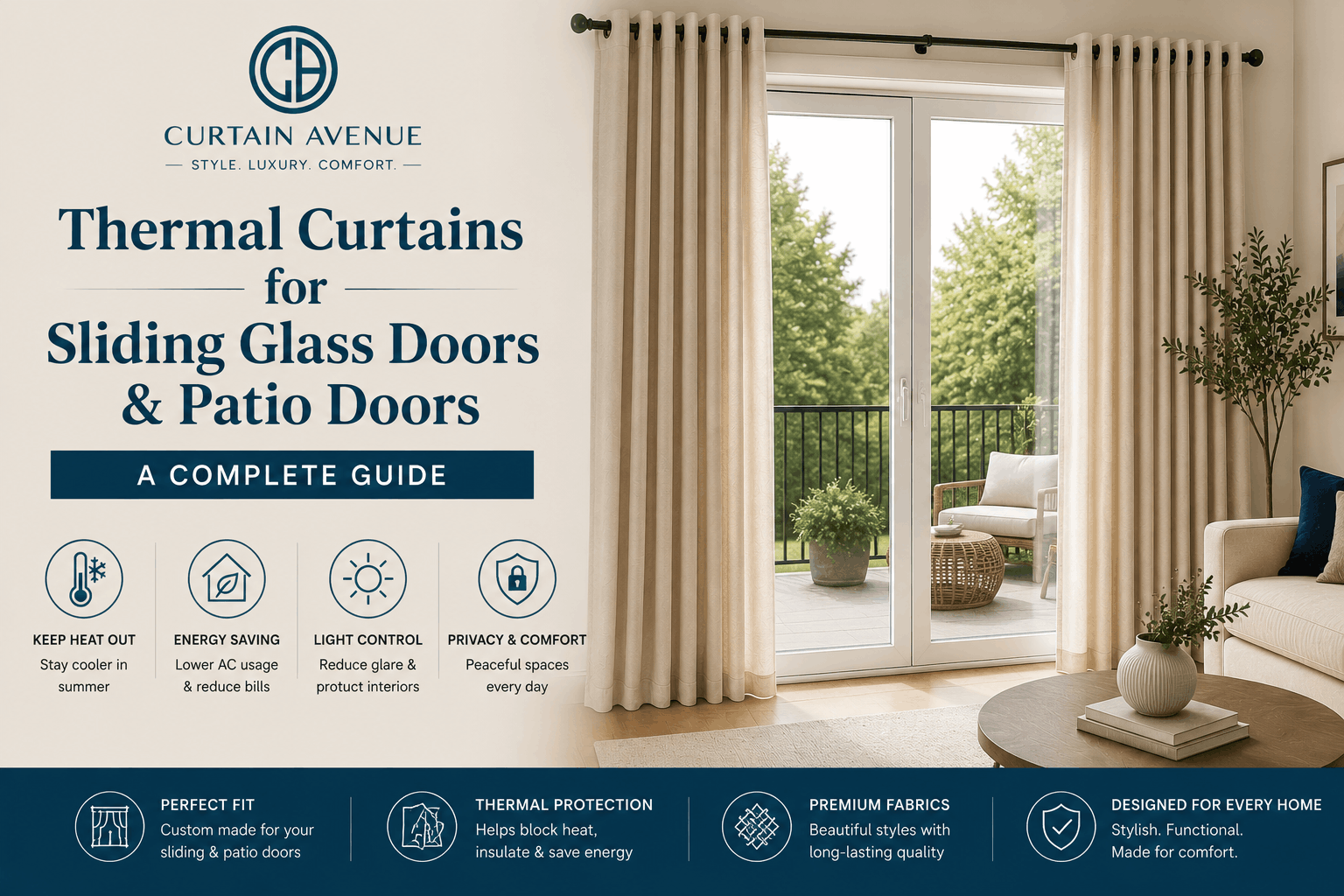
Thermal Curtains for Sliding Glass Doors & Patio Doors: A Complete Guide
Table of Contents
If you have a sliding glass door, you have the single largest source of heat gain and heat loss in your home — and most people are covering it with whatever curtain panel happened to fit.
A standard sliding glass door spans 80 inches tall and anywhere from 60 to 96 inches wide. That is a floor-to-ceiling sheet of glass with an aluminum frame. Aluminum is one of the most thermally conductive metals on earth. Glass is one of the worst insulators in residential construction. Combine the two and you have a wall section that loses heat at a rate that would be unacceptable anywhere else in your home.
The U.S. Department of Energy states plainly that single-pane glass patio doors lose far more heat than other door types because glass is a very poor insulator. Even double-pane sliding doors — which most existing homes have — still transfer heat at a rate several times higher than an insulated wall. When you factor in the sheer size of the opening, the total heat load through a sliding glass door can exceed all the other windows in the room combined.
Thermal curtains for sliding glass doors are the most cost-effective solution available. But getting them right — the sizing, the fabric, the hardware, the installation — requires specific knowledge that generic curtain guides don’t cover. This is that guide.
Why Sliding Glass Doors Are Such a Severe Thermal Problem
Most people know their sliding door is “a bit drafty” in winter or “lets the sun in” in summer. Few people appreciate how significant that heat transfer actually is until they see the numbers.
A typical double-pane sliding glass door has a U-value of approximately 0.35 to 0.50 W/m²K, compared to a well-insulated wall at 0.18 or lower. In practical terms, your sliding door is losing heat or gaining it at two to three times the rate of your insulated walls per square foot — and it has three to four times the area of a standard window.
Beyond conduction through the glass, sliding doors have three additional failure points that windows typically don’t:
The track gap. Sliding doors sit in a floor track that cannot be perfectly sealed. Cold or hot air infiltrates from outside through the gap between the door panel and the track, bypassing the glass entirely. In older doors or doors with worn weatherstripping, this draft is significant.
The center meeting point. Where the sliding panel meets the fixed panel, there is a vertical seam. In older doors, this seam allows air infiltration. In all doors, it creates a thermal bridge — a direct path for temperature transfer that the glass itself doesn’t have.
The aluminum frame. Unlike vinyl or fiberglass-framed windows, many sliding doors still use aluminum frames without thermal breaks. Aluminum conducts heat at approximately 1,600 times the rate of air. The frame becomes a radiator in summer and a heat sink in winter.
Properly installed patio door thermal curtains address all of these simultaneously. A floor-length, fully sealed thermal curtain creates an enclosed dead-air space that insulates against the glass, the frame, the track gap, and the center seam all at once. The EPA has cited a 25% reduction in heat loss from insulating curtains on glass doors — and that figure assumes standard installation. With optimised installation on a sliding glass door, the actual reduction can be considerably higher.
What Makes a Curtain Genuinely “Thermal” for a Sliding Door
The word “thermal” gets applied to curtains across an enormous range of products, from lightly lined panels to genuine multi-layer insulating drapes. On a regular window, the difference matters. On a sliding glass door — where the glass area is two to three times larger — it matters far more.
Here’s what genuinely thermal drapes for sliding glass doors need:
Multiple fabric layers. The minimum for real thermal performance is a three-layer construction: a decorative face fabric, an insulating middle layer (usually foam, batting, or dense interlining), and a reflective backing. Each layer serves a function. The face fabric blocks drafts. The insulating middle layer slows heat conduction. The reflective backing bounces solar radiation back through the glass before it converts to heat in your room.
A light-coloured or reflective window-facing lining. This is where most off-the-shelf patio door curtains fail. A dark lining on the side facing the glass absorbs solar energy and radiates it into the room — the curtain becomes a heat source rather than a heat blocker. Thermal curtains with white or silver reflective backings can reduce solar heat gain by up to 33% according to Department of Energy data. Dark linings provide a fraction of this benefit.
Fabric density that passes the light test. Hold the panel up to a bright light source. If you can see light through it — even diffused — heat is passing through it too. True thermal fabric for a sliding glass door should be fully opaque at the centre of the panel. The edges may be lighter where the backing doesn’t extend, but the main body of the curtain should block light completely.
Weight and drape. A lightweight curtain on a large sliding door will billow with air movement, breaking the seal and disrupting the dead-air pocket. Heavy, densely woven fabric stays in place and maintains the insulating air layer regardless of air currents from the door’s operation.
Sizing: The Most Common and Costly Mistake
Sizing is where most people go wrong with thermal curtains for sliding glass doors, and the consequences are significant. A curtain that doesn’t fully cover the door opening isn’t just aesthetically incomplete — it’s thermally useless at the uncovered sections.
Width
Standard sliding glass doors are 60″ wide (two-panel) or 72″ wide (larger configurations). But the correct rod width is never the door width.
Extend your curtain rod at least 12 inches beyond the door frame on each side. This does two things: it allows the curtain to stack fully off the glass when open so you can use the door freely, and when closed, it ensures the fabric overlaps the wall on both sides, eliminating the side gaps where heat enters and light leaks.
For a 72″ sliding door, your rod should span at least 96″ — and ideally 100″ to 108″. Your curtain panels need enough total fabric width to cover that span with fullness. Flat panels with no fullness lose the air-pocket insulation effect and look cheap. Plan for 1.5x to 2x rod width in total fabric. For a 100″ rod, that means 150″ to 200″ of panel width.
Many homeowners use a single 100″ wide panel for a sliding door. This works if the panel has enough fabric and the heading has sufficient pleat or gather. But two panels of 84″ to 96″ each — overlapping generously at the centre — give you more flexibility and better thermal sealing at the middle join.
Length
Floor-length is non-negotiable for patio door thermal curtains. Sliding glass doors run to the floor. Any curtain that ends above the floor creates a channel at the bottom where cold or warm air circulates freely beneath the fabric, undermining the dead-air insulation layer you’re trying to create.
Measure from the top of your rod (which should be mounted as close to the ceiling as possible — within 2–4 inches) to the floor. Add half an inch so the fabric just grazes the surface. For maximum thermal sealing, especially in winter, allowing an inch or two of puddle — fabric that rests on the floor — creates a near-perfect bottom seal.
A curtain rod at ceiling height rather than door-frame height closes the gap above the door that is otherwise exposed wall, preventing warm air from escaping above the curtain in winter and hot air from pooling above it in summer.
Hardware: Why Sliding Doors Require Different Rod Thinking
A standard straight curtain rod on a sliding glass door creates a problem that doesn’t exist on windows: the gap at each end between the back of the curtain and the wall.
On a window, this gap is annoying but manageable. On a sliding glass door, which is typically set in the middle of a room’s exterior wall with several feet of wall on each side, the gap becomes a thermal bypass — warm or cool air from around the door circulates behind the curtain through these open ends, and the insulating air pocket never fully forms.
The solution is a wraparound rod or French return rod — a rod with ends that angle back to the wall, allowing the curtain panel to wrap around and sit flush against the wall surface on both sides. When the curtain is closed, it forms a sealed enclosure: ceiling above, floor below, wall left and right, glass behind. That enclosed space traps air and insulates. An open-ended rod cannot create this condition.
If a return rod isn’t available or practical for your installation, magnetic curtain clips or hook-and-loop tape along the wall edge can serve as an alternative — pressing the curtain edge flat against the wall to close the gap.
Installation Step-by-Step: Getting Every Seal Right
Step 1 — Mount the rod high and wide
Install the rod bracket within 2–4 inches of the ceiling, extended at least 12 inches beyond the door frame on each side. Use a level. A rod that droops at the centre will cause the curtain to hang away from the wall at the sides.
Step 2 — Use a return rod or seal the edges
Install a French return rod if possible. If not, apply hook-and-loop tape or magnetic strips along the wall edge at the curtain’s return point so the fabric seals flat against the wall when closed.
Step 3 — Hang floor-length panels
Hang your thermal panels so they skim the floor with no gap. For winter installation, add a half-inch to full inch of puddle. Check that the fabric lies flat against the wall on both sides and that the panels overlap at the centre by at least 4 inches.
Step 4 — Check the top seal
Look at the space between the top of the curtain and the ceiling. If there’s a visible gap, warm air in summer will pool above the curtain and circulate behind it. A ceiling-mounted track system eliminates this gap entirely — the curtain mounts directly to the ceiling and hangs flush from the top. Alternatively, a valance or top treatment can cover the gap without requiring ceiling mounting.
Step 5 — Address the door track gap separately
Thermal curtains handle the glass and air insulation. They don’t address air infiltration through the door track itself. If your sliding door has noticeable drafts at floor level — you can feel air movement at the track on a windy day — replace or add foam weatherstripping in the track before installing the curtains. Curtains over an unsealed track will show reduced thermal performance.
Patio Door Thermal Curtains vs. Other Covering Options
People often compare thermal drapes for sliding glass doors against vertical blinds, panel track systems, and cellular shades. Here’s the honest comparison.
Vertical blinds are the default covering most sliding doors come with. They provide minimal insulation — the slats have gaps, no dead-air space forms, and the light linen or plastic material offers essentially no thermal resistance. They are cheap, functional for privacy, and nearly useless for energy efficiency.
Panel track shades are a step up — a single large panel of fabric that slides on a ceiling track. They can be made with thermal or blackout fabric and cover the door cleanly. However, they don’t stack off the door as neatly as curtains when open, and most don’t seal the edges against the wall, limiting thermal performance.
Cellular/honeycomb shades are genuinely competitive with thermal curtains for insulating value — a cellular shade can reach R-3 to R-5, comparable to a good thermal curtain. However, they must be custom-made for the exact door width to avoid side gaps, they are significantly more expensive, and they limit the aesthetic flexibility that curtains provide. For a purely functional install where appearance is secondary, cellular shades are an excellent alternative.
Thermal curtains for sliding glass doors offer the best combination of thermal performance, aesthetic flexibility, and cost. They can be custom-sized, are available in every colour and fabric style, and when correctly installed with a return rod and floor-length panels, outperform vertical blinds and standard panel tracks by a wide margin.
The Unique Challenge of Doors You Actually Use
Here’s what makes sliding glass doors different from windows in a way that affects your curtain choice: you walk through them.
A window curtain can be optimised purely for thermal performance — you don’t need it to move out of the way every time you use the window. A sliding door curtain gets opened and closed multiple times a day. This means:
The opening mechanism matters. Heavy thermal curtains on a standard rod can be difficult to operate smoothly. Grommet-top panels slide on the rod with the least resistance. Rod-pocket panels require pulling them along the rod — manageable on a lightweight curtain, frustrating on a heavy thermal panel. If you’re using the door frequently, grommets or large rings are the right choice.
Stack-off space must be planned for. When you open a sliding glass door, you need the curtain to clear the door opening completely. If your rod doesn’t extend far enough beyond the door frame, the bunched curtain fabric blocks part of the doorway or obstructs the view. Extending the rod 12–15 inches each side ensures the curtain stacks neatly off the glass when open.
Use an operating wand or pull cord. Large thermal panels are heavy. Repeatedly grabbing the fabric to open and close it wears the edge and leaves oils from your hands that affect the lining over time. A simple curtain wand clipped to the leading edge of the panel lets you operate it cleanly without touching the fabric.
Fabric Options for Patio Door Thermal Curtains
Dense Polyester with Thermal Lining
The highest-performance option for most homes. Tightly woven polyester with an acrylic foam multi-pass backing blocks heat, light, and drafts. It’s the most common construction for purpose-built patio door thermal curtains because polyester holds its shape on a large panel without sagging, cleans easily, and takes colour well.
Lined Linen or Linen-Blend
For living rooms and open-plan spaces where aesthetics matter as much as function, lined linen offers a softer, more textural look than polyester while still providing meaningful thermal performance. The linen face fabric must be combined with a proper thermal interlining and white backing — unlined linen alone has almost no insulating value. Custom curtains that allow you to choose the face fabric and specify the lining type are the best way to get this combination right.
Velvet with Thermal Backing
The most naturally insulating face fabric. Velvet’s dense pile traps air within the fabric itself, adding thermal resistance before the interlining even comes into play. Velvet thermal curtains for a sliding glass door deliver excellent performance but are heavier than polyester — ensure your rod and brackets are rated for the weight, and plan for grommet or ring mounting to allow smooth operation.
Final Checklist Before You Buy
Run through this before ordering your thermal drapes for sliding glass doors:
- Rod extends 12–15 inches beyond the door frame on each side ✓
- Rod is mounted within 2–4 inches of the ceiling ✓
- Return rod or wall-seal method selected ✓
- Total panel width is 1.5x to 2x rod width ✓
- Panel length reaches the floor (with a half-inch skim or slight puddle) ✓
- Panels overlap at the centre by at least 4 inches ✓
- Lining is white, cream, or reflective on the window-facing side ✓
- Fabric passes the light test — no light visible through the main panel body ✓
- Track weatherstripping checked and replaced if worn ✓
- Opening mechanism chosen — grommets or rings for ease of daily use ✓
When these ten conditions are met, your sliding glass door — the biggest thermal problem in most living rooms — becomes a properly sealed opening that holds temperature, reduces noise from outside, and stops contributing a disproportionate share of your heating and cooling costs every single month.
Ready to Cover Your Sliding Glass Door Properly?
At Curtain Avenue, every curtain is custom-made to your exact door dimensions. Large-panel thermal drapes for sliding glass doors are one of our most requested items — and for good reason. The right size, with the right lining, properly installed, makes the kind of difference you notice in your room temperature and your utility bill from the very first month.
Explore custom thermal curtains for sliding glass doors — free swatches ship today.
You May Also Like

How to Cover a Sliding Glass Door: Curtains vs. Blinds vs. Shades
September 25, 2026
Factor Curtains Blinds Shades Light control Good in full draw; layering with sheers gives fine control Best — tilt slats

French Door Curtains: Ideas, Fabrics & How to Choose
September 23, 2026
Doors & Beyond — Curtains on French Doors: Ideas by Room, Style, and Mounting Method
Need Help in custom window treatments ?
Our design experts are here to help you find the perfect fit for your home.

Expert Advice

Custom Made