

Thermal vs Blackout vs Sun-Blocking Curtains: Which One Do You Actually Need?
Thermal vs Blackout vs Sun-Blocking Curtains: Which One Do You Actually Need?
Table of Contents
If you’ve ever stood in a curtain aisle or scrolled through endless options online, you’ve probably had this exact thought:
Why are there so many types of curtains… and why do they all sound like they do the same thing?
Thermal. Blackout. Sun-blocking. Room darkening.
At first glance, they all seem interchangeable. They all promise comfort. They all claim to fix light or heat. But once you bring them home, that’s when reality hits. The room is still too bright. Or too warm. Or both.
I learned this the hard way in my apartment in Brooklyn, New York.
Large south-facing windows, beautiful natural light in the morning, but by afternoon, the room turned into a heat trap. I tried regular curtains first. Then “room darkening” ones. Nothing really solved the problem completely.
That’s when I started digging deeper into the difference between these options.
So if you’re stuck choosing between thermal vs blackout curtains, or trying to understand sun blocking vs room darkening, this guide will actually help you decide what you need, not just what sounds good.
First, Let’s Clear the Confusion
Before choosing, you need to understand one thing:
These curtains are not the same. They solve different problems.
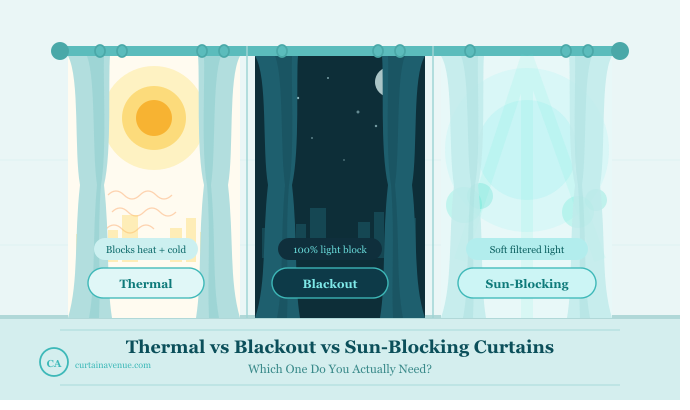
- Thermal curtains → control temperature
- Blackout curtains → block light completely
- Sun-blocking / room darkening curtains → reduce brightness, not eliminate it
Once you see them this way, everything becomes much simpler.
Thermal Curtains: Built for Temperature Control
Let’s start with the most misunderstood one.
Thermal curtains are not primarily about light. They are about heat and insulation.
How They Actually Work
Thermal curtains are made with multiple layers:
- A decorative outer fabric
- An insulating middle layer
- A backing (often foam or acrylic-coated)
These layers help:
- Block heat from entering during summer
- Retain warmth during winter
- Stabilize indoor temperature
In cities like New York, where summers can get humid and winters can be freezing, this becomes extremely useful.
Real-Life Example
In my Brooklyn apartment, switching to thermal curtains reduced the heat near my window by a noticeable margin. The AC didn’t have to work as hard, and the room stayed cooler for longer.
It wasn’t dramatic like turning on an AC, but it was consistent and practical.
When You Actually Need Thermal Curtains
- Your room gets direct sunlight for long hours
- You feel heat coming through your windows
- Your AC or heating feels inefficient
- You want better energy efficiency
If that sounds like your situation, thermal curtains are not optional. They are necessary.
Blackout Curtains: Built for Total Darkness
Now let’s talk about blackout curtains.
These are probably the most straightforward.
Blackout curtains are designed to block 100% of light.
Not reduce. Not filter. Block.
Why People Choose Blackout Curtains
The biggest use case is sleep.
If you live in New York, you already know:
- Street lights
- Early sunrise
- City glow at night
All of this affects sleep quality.
That is why blackout curtains for bedroom setups are extremely popular.
What They Actually Do
- Completely block external light
- Improve sleep quality
- Reduce glare for screens
- Provide privacy
They also have some thermal properties, but that is not their primary function.
When You Need Blackout Curtains
- Your bedroom gets too much light
- You are a light sleeper
- You work night shifts and sleep during the day
- You want a cinema-like experience in your room
If your main problem is light, blackout curtains are the right choice.
Sun-Blocking vs Room Darkening: What’s the Difference?
This is where most people get confused.
Let’s break it down simply.
Sun-Blocking Curtains
These reduce sunlight significantly but do not eliminate it completely.
Think:
- Softer light
- Less glare
- More comfort
They are perfect for living rooms where you still want natural light but without the harshness.
Room Darkening Curtains
These go a step further.
They block around 70 to 90 percent of light.
Your room becomes dim, but not pitch black.
The Key Difference
- Sun-blocking → soft, filtered light
- Room darkening → dim, low-light environment
When You Should Choose Them
- You want light but not harsh sunlight
- You want privacy without complete darkness
- You are styling a living room or workspace
When You Should Choose Them
- You want light but not harsh sunlight
- You want privacy without complete darkness
- You are styling a living room or workspace
If Your Problem is Heat → Choose Thermal Curtains
They reduce temperature, improve comfort, and help with energy efficiency.
If Your Problem is Light → Choose Blackout Curtains
They give you complete control over brightness.
If You Want Both → Combine Them
This is what most well-designed homes in New York actually do.
Layering:
- Sheer or sun-blocking curtain for daytime
- Blackout or thermal curtain for night
This gives flexibility without compromise.
What Most People Get Wrong
After trying multiple setups, here are the most common mistakes I’ve seen:
Buying Based on Looks Only
A beautiful curtain that doesn’t solve your problem is just decoration.
Assuming All Curtains Work the Same
They don’t. Fabric, layering, and construction matter a lot.
Ignoring Window Direction
South and west-facing windows need thermal protection more than anything else.
Not Measuring Properly
Gaps around curtains let in light and heat, reducing effectiveness.
What Works Best in New York Homes
Based on real usage and apartment setups:
Living Room
- Thermal or sun-blocking curtains
Allows light but reduces heat
Bedroom
- Blackout curtains
- Optional thermal lining for added comfort
Workspaces
- Room darkening curtains
Reduces glare without making the room dull
Curtain Avenue Picks That Actually Work
If you are looking for options that are already designed with these needs in mind, here are a few directions to explore.
Custom Thermal Curtains
Ideal for:
- Sun-facing windows
- Heat control
Blackout Curtains for Bedroom
Ideal for:
- Sleep quality
- Light control
So, Which One Do You Actually Need?
Let’s make this simple.
Ask yourself one question:
What bothers you more — heat or light?
- If it is heat → go for thermal
- If it is light → go for blackout
- If it is both → layer them
There is no one-size-fits-all answer. But there is always a right fit for your space.
Final Thoughts
Curtains are one of those things you don’t think much about until they start affecting your daily comfort.
Too much light. Too much heat. Poor sleep. Uneven temperature.
Once you fix it, you realise how much of a difference the right choice makes.
Understanding thermal vs blackout curtains is not just about products. It is about improving how your home feels.
Ready to Choose the Right Curtains?
If you are still unsure, start with what your space needs most and build from there.
Explore custom options designed for real homes, real sunlight, and real comfort.
Shop our custom thermal and blackout curtains — free swatches ship today.
Because the right curtain does not just change how your room looks.
It changes how you live in it.
You May Also Like

How to Cover a Sliding Glass Door: Curtains vs. Blinds vs. Shades
September 25, 2026
Factor Curtains Blinds Shades Light control Good in full draw; layering with sheers gives fine control Best — tilt slats

French Door Curtains: Ideas, Fabrics & How to Choose
September 23, 2026
Doors & Beyond — Curtains on French Doors: Ideas by Room, Style, and Mounting Method
Need Help in custom window treatments ?
Our design experts are here to help you find the perfect fit for your home.

Expert Advice

Custom Made