
Venetian Blinds: The Complete Guide to Types, Materials & Choosing the Right Ones
Window treatment How it’s built How you control light Best for Venetian blinds Horizontal slats on ladders Tilt slats +
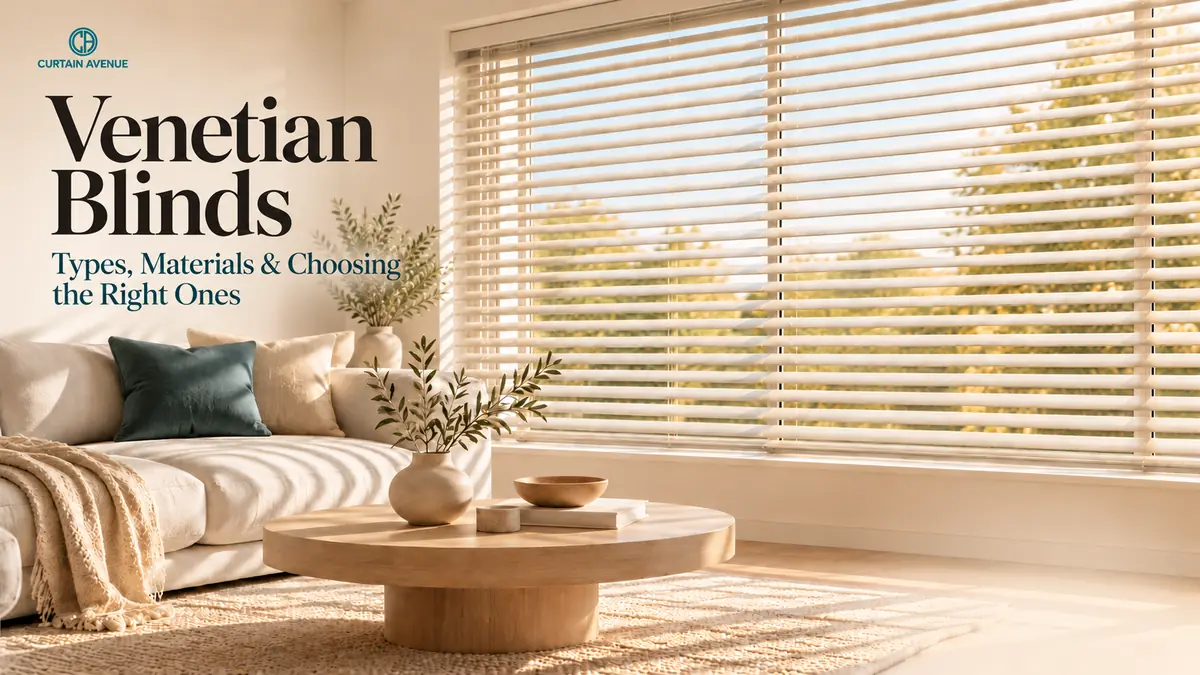
Venetian blinds are horizontal window blinds made of overlapping slats — usually wood, faux wood, or aluminum — held together by cords or fabric ladder tapes. You tilt the slats to control light and privacy, and raise the whole blind to clear the window. They’re one of the most versatile window treatments you can buy: the same blind can let in soft filtered daylight in the morning, block a neighbor’s view in the afternoon, and stack neatly out of sight when you want the full window.
This guide covers what venetian blinds are, how the main materials compare, which slat size and lift system to choose, and which blinds work best in each room of your home.
Venetian blinds are window coverings built from horizontal slats that tilt open and closed in unison and lift up into a stack at the top of the window. The slats hang from a headrail and are connected by ladder strings or decorative cloth tapes, which is what lets them rotate together. Any horizontal slatted blind — from 1-inch aluminum mini blinds to 2½-inch real wood blinds — is technically a venetian blind.
If you need a made-to-measure option, explore our custom blinds and shades for different window sizes, rooms, and control preferences.
The design has been around for centuries. An English patent for a slatted blind is commonly credited to Edward Bevan in 1769, and in the U.S., John Hampson of New Orleans was granted Patent No. 2,223 on August 21, 1841 for a mechanism that held venetian blind slats at any desired angle (Google Patents, US2223) — essentially the tilting control still in use today.
A venetian blind has six main parts:
The defining feature of venetian blinds is horizontal, tiltable slats. That’s what separates them from the window treatments people often confuse them with:
| Window treatment | How it’s built | How you control light | Best for |
|---|---|---|---|
| Venetian blinds | Horizontal slats on ladders | Tilt slats + lift the whole blind | Precise light and privacy control on standard windows |
| Vertical blinds | Vertical vanes hanging from a track | Rotate vanes + draw them to the side | Sliding glass doors and very wide windows |
| Roller shades | One continuous sheet of fabric on a roller | Raise or lower only | Clean, minimal look; blackout options |
| Roman shades | Fabric that folds into soft pleats | Raise or lower only | Softer, decorative look with fabric texture |
| Curtains / drapes | Fabric panels on a rod or track | Open or close panels | Warmth, softness, full blackout, sound absorption |
| Shutters | Fixed louvers in a hinged frame | Tilt louvers + swing panels open | Permanent, architectural installation |
What about “vertical venetian blinds”? Strictly speaking, venetian blinds are horizontal — vertical blinds are a separate product with vanes that hang from a track. Many shoppers search for “vertical venetian blinds” when they mean vertical blinds, which are the better choice for sliding patio doors because they draw sideways like a curtain instead of lifting.
And “venetian shades” or “venetian roller shades”? These names are usually used for layered or dual roller shades (sometimes called zebra shades) that alternate sheer and solid fabric stripes. They imitate the tilt-open look of a venetian blind, but they’re fabric shades, not slatted blinds.
Venetian blinds are categorized mainly by slat material. Each one handles moisture, weight, and budget differently.
Wooden venetian blinds — also sold as wood blinds or timber venetian blinds — are made from real hardwood slats, most often basswood. They’re the most premium-looking option, with natural grain and warmth that faux materials can only imitate. Real wood is also surprisingly light, which makes it the better choice for very wide or tall windows where a heavier blind would be hard to lift.
Faux wood venetian blinds are made from PVC, vinyl, or a composite that mimics painted or stained wood. From across a room they look nearly identical to real wood, but they’re moisture-resistant, easier to wipe clean, and usually less expensive. The trade-off is weight: faux wood is noticeably heavier than real wood, so very wide faux wood blinds can be harder to lift by hand.
Aluminum venetian blinds — the classic “mini blinds” — use thin metal slats, most often 1 inch wide (sometimes ½ inch for “micro” blinds). They’re the most budget-friendly venetian blind, resist moisture well, and their slim slats stack tightly, which makes them a smart fit for shallow window frames and doors. They can dent or bend if handled roughly.
Vinyl and PVC venetian blinds are entry-level, moisture-resistant options often used in rentals and utility spaces. Fabric venetian blinds use fabric-wrapped slats for a softer, quieter look, but they collect dust more easily and need more careful cleaning.
Choose real wood for living spaces where appearance matters most, faux wood for any room with humidity or heavy daily use, and aluminum for the lowest cost, shallow frames, and doors. This side-by-side comparison summarizes the trade-offs:
| Real wood | Faux wood | Aluminum | |
|---|---|---|---|
| Look | Premium, natural grain | Close match to painted/stained wood | Sleek, modern, minimal |
| Moisture resistance | Low — can warp | High | High |
| Weight | Lightest per slat for its size | Heaviest | Very light |
| Best max width | Widest spans | Narrower spans (can sag) | Wide spans |
| Durability | Good; can scratch | Very good; easy to wipe | Fair; slats can dent or bend |
| Relative cost | Highest | Mid-range | Lowest |
| Best rooms | Living, dining, bedroom, office | Bathroom, kitchen, kids’ rooms | Kitchen, office, doors, utility |
2-inch slats are the most popular all-around choice for wood and faux wood venetian blinds: they look proportionate on most standard windows, give a clear view when open, and need fewer slats (so the blind stacks smaller). 1-inch slats suit smaller windows, doors, and shallow frames. 2½-inch slats give a more contemporary, shutter-like look on large windows and offer the widest view when open.
A practical rule of thumb: the larger the window, the larger the slat can be. On a small bathroom window, 2½-inch slats can look oversized; on a tall living room window, 1-inch slats can look busy.
Venetian blinds come with three main ways to raise and lower them, and the choice affects safety as much as convenience.
Why cordless and motorized matter for safety: since December 15, 2018, the U.S. window covering industry has followed the ANSI/WCMA A100-2018 standard, which requires stock window coverings sold in the U.S. to be cordless or have inaccessible or short cords, to reduce strangulation risk to young children (CPSC; Window Covering Safety Council). If you have small children or pets, choose cordless or motorized venetian blinds.
Not sure which control system suits your windows? Our custom blinds consultation can help you compare cordless and motorized options based on window size, accessibility, and daily use.
No — venetian blinds reduce light dramatically but don’t create true blackout. Even with the slats fully closed, light leaks through the small holes where the lift cords pass through the slats (called route holes), through the tiny gaps between slats, and around the edges of the blind. For rooms that need significantly stronger room darkening, consider layering the blinds with custom blackout curtains.
To get closer to blackout with venetian blinds:
Inside mount places the blind within the window frame for a clean, built-in look; outside mount mounts the blind on the wall or trim above the window so it covers the frame. Choose inside mount when your window frame is deep enough and square; choose outside mount when the frame is shallow, when you want to hide an unattractive frame, or when you want maximum light blocking.
How deep does a window frame need to be for inside-mount venetian blinds? It depends on slat size. 1-inch aluminum mini blinds need very little depth, while 2-inch wood and faux wood blinds typically need around 2 to 3 inches of frame depth to sit fully flush, so the slats can tilt without hitting the glass or window cranks. Always check the manufacturer’s minimum and “fully recessed” depth for the exact blind you order.
For inside-mount custom blinds, give the exact frame measurements; the factory takes the small deduction needed for clearance.
Yes — wood and faux wood venetian blinds remain one of the most popular window treatments in American homes, and wider 2½-inch slats in natural wood tones, matte whites, and warm neutrals feel especially current. What dates a venetian blind is usually the details, not the style itself: yellowed plastic, bent aluminum slats, and visible cords read as outdated, while clean cordless or motorized wood blinds layered with tailored drapery look polished and modern.
Venetian blind pricing depends on four main factors: material (aluminum costs least, faux wood sits in the middle, real wood costs most), window size, ready-made vs. custom sizing, and upgrades such as routeless slats, decorative cloth tapes, cordless lifts, or motorization. Motorization is typically the single largest upgrade cost on any blind.
Ready-made venetian blinds are cheaper but only come in standard widths, which often leaves light gaps on real-world windows. Custom venetian blinds are made to your exact measurements, so they fit inside the frame without gaps and let you choose the precise color, slat size, and lift system — the better value for any window you see every day.
Because pricing depends on measurements, materials, and control options, the most accurate next step is to book a free window-treatment consultation.
What are venetian blinds?
Venetian blinds are horizontal window blinds made of slats that tilt together to control light and privacy and lift up to clear the window. They’re most commonly made of real wood, faux wood, or aluminum.
What is the difference between wooden blinds and venetian blinds?
There isn’t one, technically — wooden blinds are a type of venetian blind. “Venetian blind” describes the horizontal tilting-slat design, while “wooden” describes the slat material. Aluminum mini blinds and faux wood blinds are venetian blinds too.
Are wooden blinds good insulators?
Real wood is a natural insulator, so wood venetian blinds offer some protection against heat and cold, especially when closed. Because there are small gaps between slats, they insulate less than cellular shades or lined curtains; layering both gives the best result.
Are wooden blinds suitable for bathrooms?
Real wood blinds are not recommended for bathrooms, since steam and humidity can cause the slats to warp or crack. Faux wood or aluminum venetian blinds are the better choice — they look similar and handle moisture well.
Are wooden blinds blackout?
No. Wooden venetian blinds block most light when closed but let some through the route holes, slat gaps, and edges. For near-blackout, choose routeless slats with an outside mount, or layer the blinds with blackout curtains.
Are faux wood blinds better than real wood?
Faux wood is better for humid rooms, households with kids or pets, and budget-conscious projects, because it’s moisture-resistant and easy to clean. Real wood is better for appearance, very wide windows (it’s lighter), and premium living spaces.
Should blinds cover the window frame?
Only with an outside mount. Inside-mount blinds sit within the frame and leave the trim visible, while outside-mount blinds cover the frame and overlap the wall, which improves privacy and light blocking and makes small windows look larger.
Can you paint faux wood blinds?
You can, but it’s rarely worth it — paint can chip, make the slats stick together, and interfere with tilting. Ordering new blinds in the color you want usually gives a cleaner, longer-lasting result.
How do you clean venetian blinds?
Close the slats and dust them with a microfiber cloth or a vacuum brush attachment, then tilt them the other way and repeat. Faux wood and aluminum blinds can be wiped with a damp cloth and mild soap; real wood should only be dusted or wiped with a barely damp cloth and dried immediately.
Venetian blinds give you more control over light and privacy than almost any other window treatment, because you can tilt the slats as well as raise the blind. Pick real wood for living spaces where the look matters most, faux wood for humid or high-traffic rooms, and aluminum for budget, doors, and shallow frames. Choose 2-inch slats as your default, go cordless or motorized in any home with children or pets, and layer with curtains wherever you need true blackout.
Want venetian blinds made to your exact windows? Curtain Avenue offers a free consultation, free samples, and custom sizing with cordless and motorized options — and pairs blinds with custom drapery for a complete, layered look.
Book your free consultation or visit our showroom at 470 Walt Whitman Rd, Huntington Station, NY.
Window treatment How it’s built How you control light Best for Venetian blinds Horizontal slats on ladders Tilt slats +

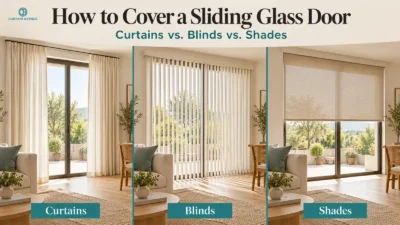
Factor Curtains Blinds Shades Light control Good in full draw; layering with sheers gives fine control Best — tilt slats
Our design experts are here to help you find the perfect fit for your home.