
Venetian Blinds: The Complete Guide to Types, Materials & Choosing the Right Ones
Window treatment How it’s built How you control light Best for Venetian blinds Horizontal slats on ladders Tilt slats +
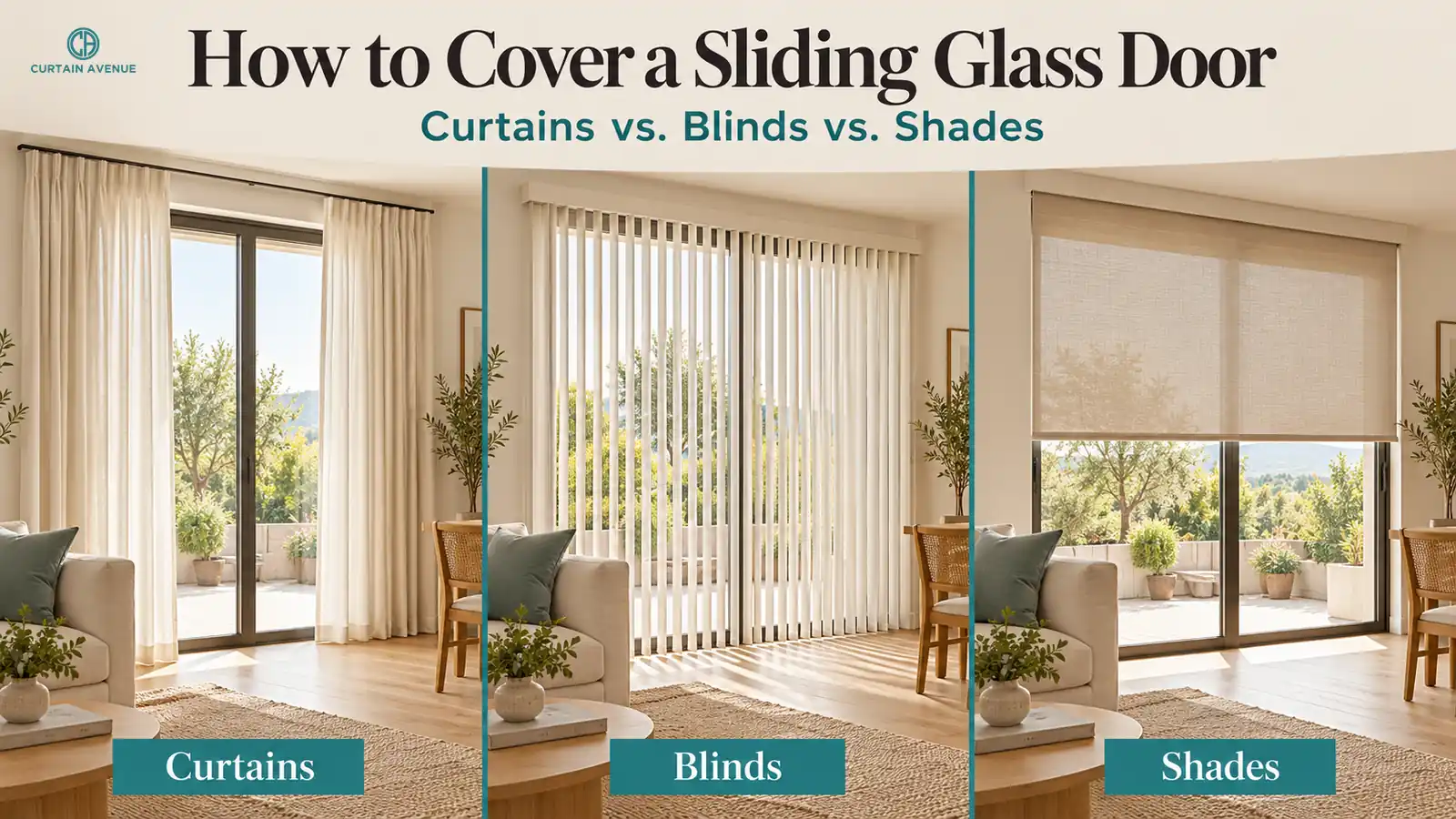
The best covering for a sliding glass door depends on what you need most: curtains give you the softest look, the best insulation, and the easiest daily operation; blinds give you the most precise light control in the smallest footprint; and shades — especially motorized ones — give you the cleanest, most hands-free operation for a door you open and close constantly. Most sliding doors are actually best served by combining two of the three rather than picking just one.
That’s a more useful answer than “it depends,” so here’s how to actually decide, factor by factor, for a door that — unlike a regular window — gets walked through, opened, and closed every single day.
| Factor | Curtains | Blinds | Shades |
|---|---|---|---|
| Light control | Good in full draw; layering with sheers gives fine control | Best — tilt slats to any angle | Good to excellent (cellular/solar shades add insulation) |
| Privacy | Excellent, especially lined | Good; slats leave small gaps when tilted | Excellent, especially cellular or blackout |
| Insulation | Best — fabric and lining trap air at the glass | Weakest — slats leave gaps for drafts | Very good — cellular shades are the most efficient option of the three |
| Daily use (open/close) | Easy — pull to the side, out of the door’s path | Easy but slats can catch or bend with frequent use | Effortless with motorization; manual lift shades need two hands |
| Upfront cost | Mid-to-high, scales with fabric and width | Lowest of the three | Mid-to-high, especially motorized |
| Style range | Widest — any fabric, color, header style | More utilitarian, though wood/faux-wood adds warmth | Clean, architectural, minimal |
| Best for | Living rooms, bedrooms, anywhere softness and warmth matter | Small footprint needs, rentals, budget-first decisions | Modern rooms, motorized/smart-home setups, energy-conscious homes |
Source: comparison built from product and material characteristics common to all three treatment types; exact pricing depends on door size, fabric, and motorization — get a custom quote for your own door’s numbers.
Curtains are the right call when insulation, softness, and style matter more than having the absolute tightest light seal. Fabric panels trap a layer of air against the glass the way a single-pane slat or shade can’t, which is why curtains are consistently rated the best-insulating option of the three for a door that’s often a home’s single largest source of heat loss or gain. They’re also the only option that layers cleanly — a sheer panel for daytime privacy under a heavier blackout or thermal panel for night is a standard combination that neither blinds nor shades can replicate on their own.
The tradeoff: curtain panels need real fullness (roughly twice the rod width) to stack back neatly when the door is open, so they take up more wall space beside the door than a blind or shade that packs into a headrail a few inches deep. In a tight room, that’s worth planning around before you order.
Curtain Ideas for Sliding Glass Doors →
Blinds are the right call when you want the most granular light control in the smallest possible footprint. Tilting the slats lets you let light in while blocking a direct sightline — a middle setting curtains and most shades can’t offer without being partway open. Vertical blinds in particular were built for sliding doors specifically: the individual vanes stack to one side along the same horizontal path the door itself travels, so they’ve long been the default in rentals and budget-conscious installs.
The tradeoff shows up in daily use and insulation. Slats are the weakest of the three at blocking drafts, since air moves through the gaps between them even when closed, and frequent use — pushing panels aside to walk through the door multiple times a day — is what wears vertical blind mechanisms out fastest. Vertical blinds also read as dated in most updated interiors; panel track blinds (below) solve the daily-use problem with a more current look.
Shades are the right call when you want the cleanest possible look and are willing to pay for motorization to make a wide, heavy shade practical to operate daily. Cellular (honeycomb) shades are the most energy-efficient option of all three, trapping air in their honeycomb structure the way curtains trap it in fabric folds, which makes them a strong pick for a door that faces direct sun or an uninsulated patio. Solar shades hold onto the view while cutting glare and UV, which curtains and blinds both sacrifice to some degree when closed.
The tradeoff is width and weight. A shade sized for a wide sliding or patio door is heavy enough that manually raising and lowering it daily gets old fast — this is the one category of the three where motorization goes from “nice to have” to “close to necessary” for a door you actually use.
Can you use curtains and blinds together on a sliding door? Yes, and for a door that’s used daily, layering is often the better answer than picking just one. A common approach is a shade or blind mounted directly on the door for daily privacy and light control, with curtain panels layered outside it purely for softness, framing, and a finished look — the panels can stay mostly open since the shade or blind handles the everyday function.
Panel track blinds are worth calling out separately because they’re purpose-built to solve the daily-use problem that vertical blinds and curtains both have to some degree: wide fabric or vinyl panels glide on a horizontal track the same way the door itself slides, giving a cleaner, more architectural look than slatted vertical blinds while still stacking fully to one side. They’re a strong middle option if the goal is something closer to blinds functionally but closer to curtains visually.
Blinds are typically the lowest upfront cost of the three, since they use less material and simpler hardware than a full curtain treatment or a wide shade. Curtains and shades land in a similar mid-to-high range, with the final cost driven more by fabric choice and door width than by which category you pick — and motorization, when added to shades or blinds, is usually the single biggest line-item cost of any of the three options. Because pricing depends heavily on your specific door’s dimensions and the fabric or material you choose, the most accurate comparison is to price your actual door across two or three options rather than relying on general rules of thumb.
A sliding glass door isn’t a static window — it gets walked through and operated multiple times a day, and that changes which option holds up best. Curtains handle this the most gracefully, since panels simply move out of the way with no mechanical parts to wear out. Blinds and shades both depend on a lift or tilt mechanism that sees more cycles on a frequently used door than it would on a regular window, which is the main reason motorized options exist for this category in the first place — a motor is built for repeated daily cycles in a way a manual cord or wand isn’t always designed to withstand long-term.
Blackout Curtains for Sliding Glass & Patio Doors →
Are curtains or blinds better for a sliding glass door?
Curtains generally win on insulation, softness, and style, while blinds win on light-control precision and footprint. For daily insulation performance, curtains have the edge; for the smallest space impact and lowest cost, blinds do.
What is the cheapest way to cover a sliding glass door?
Blinds are typically the lowest-cost option of the three, since they require less material and simpler hardware than full-width curtain panels or a wide shade. Vertical blinds specifically are the most budget-friendly choice built for a sliding door’s stacking motion.
Can I use curtains and blinds together on a sliding door?
Yes — layering a blind or shade directly on the door for daily function with curtain panels outside it for softness and style is a common approach, especially on doors used often, since the shade or blind can handle daily privacy while the curtains stay mostly open.
Do blinds or curtains offer better privacy on a patio door?
Both can offer excellent privacy when fully closed, but curtains — especially lined ones — block sightlines more completely than blinds, whose slats can leave small gaps even when tilted closed. For maximum privacy with some light, a cellular or blackout shade closes just as completely as curtains without the gaps blinds can have.
Are vertical blinds outdated for sliding glass doors?
Vertical blinds are widely seen as dated in updated interiors, even though they remain common in rentals for their low cost and functional fit with a door’s stacking motion. Panel track blinds are the more current alternative — they move the same way but use wide, solid fabric or vinyl panels instead of individual slats.
Which is easiest to keep clean: curtains, blinds, or shades?
Blinds are the easiest to spot-clean with a damp cloth or duster since they’re a hard or semi-hard surface. Curtains generally need more involved cleaning — vacuuming, spot treatment, or occasional professional cleaning depending on fabric — while shades fall in between, usually needing just a wipe-down or light vacuum.
There’s no single right answer between curtains, blinds, and shades for a sliding glass door — the right choice depends on whether insulation and softness, tight-budget simplicity, or clean hands-free operation matters most in your space, and layering two of the three is a legitimate answer rather than a compromise. Curtain Avenue makes all three — custom curtains, motorized blinds, and roman and outdoor shades — so you can compare real options for your exact door rather than guessing from general pros and cons.
Sources and further reading
Ready to see what fits your door? Get a free custom quote and we’ll walk you through curtains, blinds, and shades for your specific sliding or patio door.
Window treatment How it’s built How you control light Best for Venetian blinds Horizontal slats on ladders Tilt slats +
Factor Curtains Blinds Shades Light control Good in full draw; layering with sheers gives fine control Best — tilt slats
Our design experts are here to help you find the perfect fit for your home.