
Venetian Blinds: The Complete Guide to Types, Materials & Choosing the Right Ones
Window treatment How it’s built How you control light Best for Venetian blinds Horizontal slats on ladders Tilt slats +
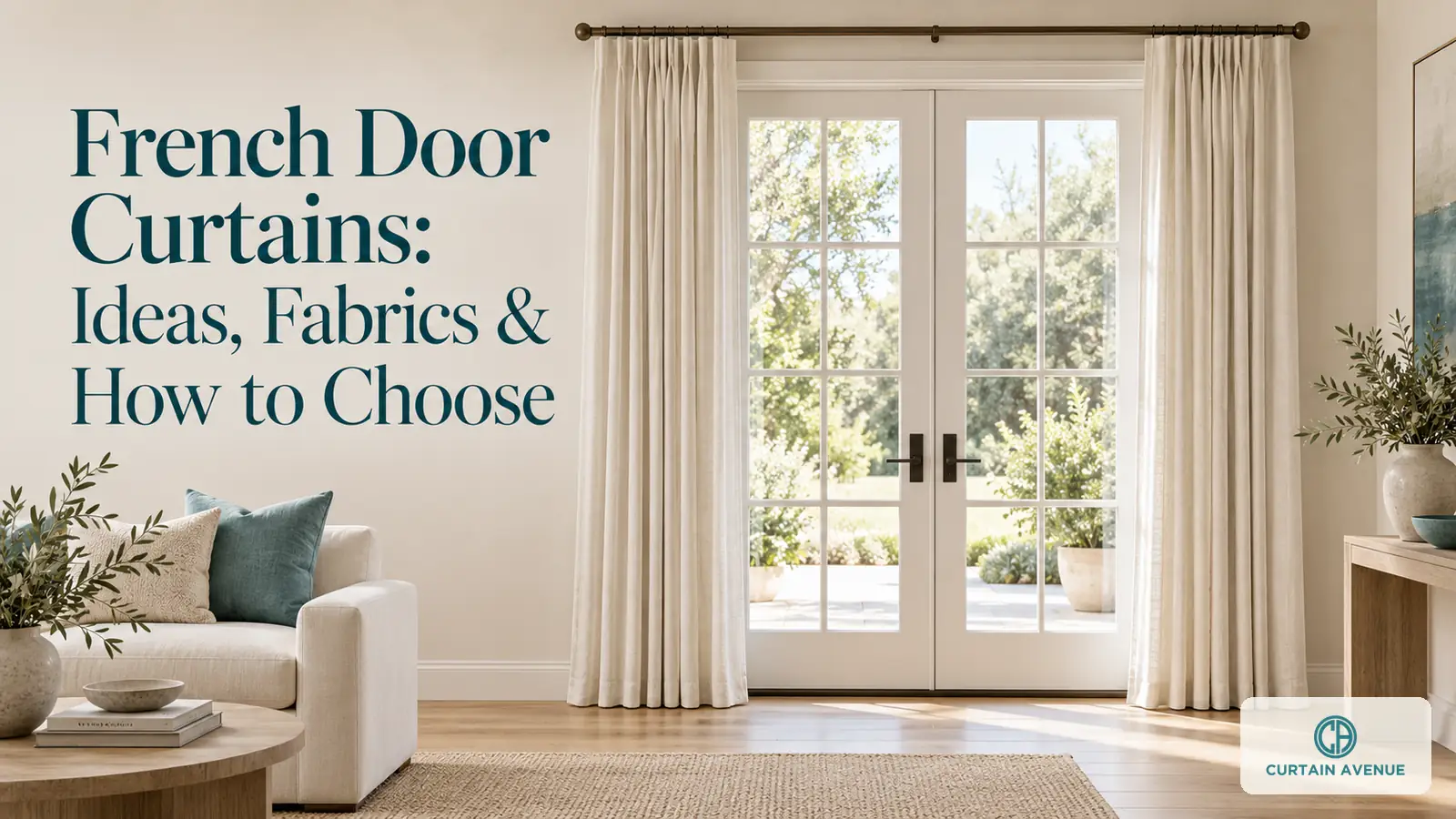
The best curtains for French doors either mount on the wall or ceiling above the entire opening — for the fullest, most traditional look — or mount directly on each door panel with a slim sash rod, which is the better choice when the doors swing open often and you don’t want fabric hanging loose in the doorway. Fabric weight matters more here than on almost any other window: a heavy blackout panel drags on hinges and door-mounted hardware in a way a lighter fabric doesn’t.
French doors create a problem no other window treatment guide fully solves: two separate door panels that swing open independently, on hinges, often in opposite directions. Get the mounting method right for how your doors actually get used, and everything else — fabric, style, length — falls into place.
French doors are a pair of hinged panels that swing open independently, which means a curtain treatment has to account for movement a static window never deals with. Any curtain spanning both doors as one continuous panel — the default approach for a regular window — gets caught the moment one door opens without the other, so French doors force a choice most windows don’t: mount the curtain to clear both doors’ full range of motion (wall or ceiling-mounted, spanning the whole opening) or mount it to each door individually so the fabric moves with the door (door-mounted sash rods).
Should curtains for French doors be mounted on the wall or the door? Mount on the wall or ceiling when you want the fullest, most traditional drapery look and the doors aren’t opened constantly — this is the closest approach to dressing a regular large window, with a rod extended 8-12 inches past each side of the door frame so panels stack fully clear of the glass when open. This method gives the most fabric, the most style flexibility (any header, any fullness), and the cleanest look when the doors are closed, but the curtains need to be pulled fully open before either door swings, so it’s a poorer fit for a door used many times a day.
What is a sash rod and when should I use one for French doors? A sash rod is a slim rod mounted directly onto each individual door panel, so the curtain moves with the door every time it opens — the right choice when French doors swing open frequently and loose fabric spanning the whole opening would constantly be in the way. Because the curtain is attached to the door itself rather than the wall, fabric weight matters enormously here: a lightweight cotton, linen, or sheer panel moves easily with the door, while a heavy blackout or lined panel adds real drag and strain on both the hardware and the door’s hinges over time. This is also the one case where a rod pocket header is genuinely a good fit rather than something to avoid — a short rod mounted on a single door panel doesn’t have the wide-track dragging problem a rod pocket creates on a long sliding door rod, so the classic gathered rod-pocket look works well here.
A curtain track — as opposed to a round rod — is worth considering when you want a more contemporary look or need to support a heavier fullness (ripple fold or a dense pinch pleat) than a standard rod comfortably carries. Tracks distribute weight differently than a rod and glide smoothly, which makes them a strong pick when the doors themselves aren’t being used constantly but you still want a cleaner mechanism than curtain rings on a rod.
Not all French doors lead outside — interior French doors (between a living room and a home office, say) and exterior or patio French doors have different priorities. Interior French doors are mostly about light filtering, sound softening, and style, since insulation and weather aren’t factors — a lighter fabric and simpler mounting usually make sense.
Exterior or patio French doors need the same insulation and privacy considerations as any door to the outside: a thermal or blackout lining is worth the upgrade, and — since these are often the widest, most-used door in a room — the sash-rod, door-mounted approach tends to make more practical sense than full wall-mounted panels.
Exterior glass doors can also contribute to heat gain and winter heat loss. Read our guide to thermal curtains for patio doors for additional insulation and installation guidance.
Choose fabric weight based on the mounting method: door-mounted curtains need something light enough to move easily with the door — cotton, linen, or a lightweight blend — while wall or ceiling-mounted curtains that don’t move with the door can be any weight, including heavier velvet or lined blackout fabric, since the hardware and hinges never bear that weight. Sheer or semi-sheer fabric is a common choice for French doors specifically because the glass typically runs the full height of both panels, and sheers soften a “fishbowl” feeling during the day without losing the light a French door is usually installed to bring in.
For softly filtered daylight, explore our custom sheer curtains. If privacy and stronger light control are priorities, select a heavier fabric with dimming or blackout lining.
Spiffy Spools — French Door Curtains: Ideas, Photos & Tips
Curtain fullness for French doors should be at least 1.5 times the rod width, and 2 to 3 times for a denser, more formal look — the same fullness principle that applies to any drapery, though French doors often use less fullness than a wide sliding door simply because each panel covers a narrower span.
On a wall-mounted setup covering both doors, extend the rod 8-12 inches past each side so panels can stack fully off the glass; on a door-mounted sash rod setup, the rod is sized to the individual door panel’s width, not the full opening, since each door gets its own rod.
Before ordering, follow our curtain measurement guide to calculate the correct width, length and fullness for your French doors.
Doors & Beyond — Curtains on French Doors: Ideas by Room, Style, and Mounting Method
Should French door curtains be mounted on the wall or the door itself?
Mount on the wall or ceiling, spanning the whole opening, when you want the fullest traditional look and the doors aren’t opened constantly. Mount directly on each door with a sash rod when the doors swing open often, so the curtain moves with the door instead of hanging loose in the doorway.
Can you use rod pocket curtains on French doors?
Yes — unlike a wide sliding door, where rod pocket curtains bunch and snag on a long track, a rod pocket works well on French doors when it’s mounted on a short, door-mounted sash rod, since there’s no long track for the fabric to drag on.
Do French door curtains need to be blackout?
Not always. Interior French doors usually don’t need blackout since insulation and total privacy aren’t priorities, while exterior or patio French doors benefit from a blackout or thermal lining the same way any exterior door does, especially in a bedroom.
How wide should curtains be for French doors?
Aim for at least 1.5 times the width of the rod for basic fullness, or 2 to 3 times for a denser, more formal look. A wall-mounted rod should extend 8-12 inches past each side of the full door opening; a door-mounted sash rod is sized to that individual panel’s width.
What fabric is best for curtains that mount directly on a French door?
A lightweight fabric — cotton, linen, or a light blend — works best for door-mounted curtains, since the fabric moves with the door every time it opens and a heavy or lined fabric adds drag on the hardware and hinges over time.
Are curtains different for interior French doors versus exterior French doors?
Yes. Interior French doors mainly need light filtering and style, since weather and insulation aren’t factors, so lighter fabric and simpler mounting are usually enough. Exterior or patio French doors benefit from the same insulation and privacy considerations as any exterior door, making a thermal or blackout lining worth considering.
French door curtains come down to one decision that determines everything else: does the curtain need to move with the door, or can it stay put while the door swings clear beneath it? Answer that first — based on how often the doors actually get used — and the mounting method, fabric weight, and style choices that follow are straightforward from there.
Ready to get the right curtains for your French doors? Start your custom curtains quote and tell us how your doors are mounted and used, and we’ll recommend the right fabric and hardware for your space.
Window treatment How it’s built How you control light Best for Venetian blinds Horizontal slats on ladders Tilt slats +

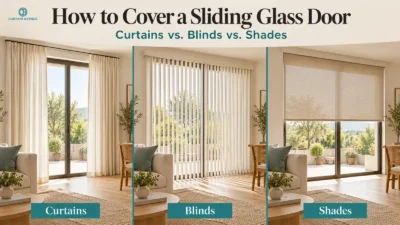
Factor Curtains Blinds Shades Light control Good in full draw; layering with sheers gives fine control Best — tilt slats
Our design experts are here to help you find the perfect fit for your home.