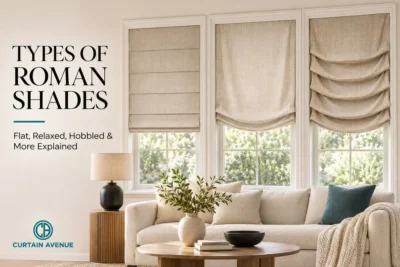
Types of Roman Shades: Flat, Relaxed, Hobbled and More Explained
Style How it looks lowered Formality Stack when raised Best fabrics Best rooms Flat (classic) Smooth, flat panel Modern to

The main types of roman shades are flat, relaxed, hobbled, balloon, London and knife pleat. They differ in how the fabric folds. Flat roman shades lie smooth when lowered and stack into neat, even folds. Relaxed roman shades have a soft curve at the bottom. Hobbled roman shades keep cascading loops of fabric even when fully down. Balloon and London shades gather into soft poufs at the hem. Flat and relaxed are the most popular because they suit almost any room.
This guide explains what roman shades are, how each style looks and works, and which style suits each room, fabric and light need.
Roman shades are fabric window shades that fold up into horizontal pleats when you raise them. When lowered, they cover the window as a single flat or softly shaped panel. Unlike curtains, which hang beside the window and slide sideways, roman shades move up and down and sit inside or just above the window frame.
Roman shades work with a lift system of cords, rings and rods on the back of the fabric. When you raise the shade, the cords pull the bottom up and the fabric folds at each row of rings or rods, stacking at the top of the window. The rods and fold lines are what make each style different. Flat shades have stiff rods across the full width, relaxed shades leave the bottom rod out, and hobbled shades space extra fabric between rods.
Most custom roman shades are now made with a cordless lift or a motor instead of loose cords, which is safer for children and pets. Our cordless vs motorized roman shades guide compares the two.
| Style | How it looks lowered | Formality | Stack when raised | Best fabrics | Best rooms |
|---|---|---|---|---|---|
| Flat (classic) | Smooth, flat panel | Modern to tailored | Compact | Patterns, stripes, linen, blackout | Kitchens, offices, bedrooms, dining rooms |
| Seamless flat | Smooth panel with no horizontal seams | Modern, minimal | Compact | Large prints, textured weaves | Modern living rooms, bedrooms |
| Relaxed (European) | Soft curve or “smile” at the bottom hem | Casual, soft | Moderate | Linen, cotton, lightweight solids | Bedrooms, living rooms, breakfast nooks |
| Hobbled (soft fold) | Cascading loops of fabric top to bottom | Most decorative; traditional | Largest | Solid colours, textured fabrics | Formal living and dining rooms, primary bedrooms |
| Balloon | Gathered puffs along the lower edge | Formal, romantic | Large | Lightweight silks, taffeta, cotton | Formal dining rooms, traditional bedrooms |
| London (tulip) | Soft swags with pleats at each side | Traditional, cottage | Large | Soft cotton, chintz, floral prints | Cottage and vintage rooms, guest bedrooms |
| Knife pleat | Crisp, sharp folds | Modern, structured | Compact | Firm, mid-weight fabrics | Contemporary rooms, offices |
Flat roman shades lie completely smooth when lowered and fold into neat, evenly spaced pleats when raised. They are the most popular roman shade style because they work in almost any room. The smooth panel shows off a pattern without breaking it up, so flat folds are the best choice for stripes, florals and geometric prints.
A flat roman shade has stiff rods sewn across its full width, which keeps each fold crisp and the stack compact. That compact stack matters on short windows, where a bulky stack would block the view. Flat shades also take a blackout lining well, since the flat face covers the window evenly.
Choose flat if: you want a clean, tailored look, a patterned fabric, or the most light coverage.
Relaxed roman shades, also called European or soft roman shades, have a gentle curve at the bottom hem. The bottom rod is left out, so the centre of the shade dips slightly lower than the sides. This gives a soft, casual look that suits linen and other lightweight fabrics.
Relaxed shades are the second most searched roman shade style in the US, with about 1,900 searches a month (Semrush, 2026). They are a natural fit for bedrooms, coastal and farmhouse rooms, and breakfast nooks. Because the hem is curved, the bottom corners leave small gaps for light, so relaxed shades work best where full blackout isn’t needed.
Choose relaxed if: you want a soft, lived-in look, or you’re using linen.
Hobbled roman shades, also called soft-fold or teardrop shades, keep rows of loose fabric loops from top to bottom, even when fully lowered. Extra fabric is sewn between each fold, so the shade looks layered and full at all times.
Hobbled shades are the most decorative roman shade style and suit traditional, formal rooms. The extra fabric also means they stack higher when raised, so they need a taller window or an outside mount above the frame. Solid colours and textured fabrics show the loops best, because a busy pattern gets lost in the folds.
Choose hobbled if: you want a rich, traditional look and have a tall window.
Balloon and London shades are the most decorative styles. A balloon shade gathers into rounded puffs along the bottom edge. A London shade, also called a tulip shade, has inverted pleats at each side that let the fabric hang in a soft swag across the middle.
Both styles stack large and work best as a mostly-raised, decorative treatment rather than one you open and close every day. They suit formal dining rooms, traditional bedrooms and cottage-style homes.
Linen roman shades are the most searched roman shade fabric, with about 3,600 searches a month in the US (Semrush, 2026). Linen gives a natural, textured look that pairs especially well with a relaxed or flat fold. Unlined linen filters light softly. Add a privacy or blackout lining for bedrooms.
Linen creases and can fade in strong sun, so a lining also protects it. In bathrooms and kitchens, a linen-look polyester blend gives the same texture with better resistance to moisture and stains. Our guide on how to measure and choose roman shades covers fabric choices by room.
Yes. Roman shades remain popular because they sit neatly in the window, take up no wall space and work with both modern and traditional rooms. Flat and relaxed roman shades in linen and natural textures are especially popular right now. Roman shades also pair well with curtains, so you can layer them for more softness.
Yes. Mount the roman shade inside the window frame, or just above it, for light control. Then hang curtain or drapery panels on a rod mounted 4–6 inches above the frame and 6–10 inches past each side. The panels can be stationary for decoration or working panels that close at night.
The main types are flat, relaxed, hobbled, balloon, London and knife pleat. Flat shades lie smooth, relaxed shades curve at the hem, hobbled shades keep cascading loops, and balloon and London shades gather into soft poufs. Flat and relaxed are the most popular.
A flat roman shade lies smooth when lowered and folds into a compact stack. A hobbled roman shade keeps loops of fabric from top to bottom even when lowered, uses more fabric and stacks higher. Flat looks modern and tailored; hobbled looks traditional and decorative.
A relaxed roman shade has no rod at the bottom, so the hem forms a soft curve that dips in the centre. It gives a casual, soft look and suits linen and lightweight fabrics in bedrooms and living rooms.
A flat roman shade with a blackout lining blocks the most light, because its smooth face covers the window evenly. Relaxed shades leave small gaps at the curved bottom corners. An outside mount that overlaps the frame also reduces light gaps at the sides.
Flat and knife pleat roman shades have the smallest stack when raised. Hobbled, balloon and London shades stack largest because they use extra fabric in each fold.
Yes. Roman shades remain popular because they sit neatly in the window and suit both modern and traditional rooms. Flat and relaxed styles in linen and natural textures are especially popular.
Pick a roman shade style by the look you want and how you use the window. Flat roman shades are the most versatile and the best for patterns and blackout. Relaxed shades soften a room, especially in linen. Hobbled, balloon and London shades add a traditional, decorative finish where you have the window height for a bigger stack.
Ready to see the styles on your own windows? Explore custom roman shades, or book a free design consultation on Long Island and we’ll bring fabric samples and measure every window.
Style How it looks lowered Formality Stack when raised Best fabrics Best rooms Flat (classic) Smooth, flat panel Modern to
Drapes Curtains Fabric Medium to heavy: velvet, silk, wool, heavy linen Light to medium: cotton, linen, polyester, sheers Lining Almost
Length Where the hem ends Best for Float (recommended) ½ inch above the floor Most dining rooms; tailored and practical
Our design experts are here to help you find the perfect fit for your home.