
Venetian Blinds: The Complete Guide to Types, Materials & Choosing the Right Ones
Window treatment How it’s built How you control light Best for Venetian blinds Horizontal slats on ladders Tilt slats +
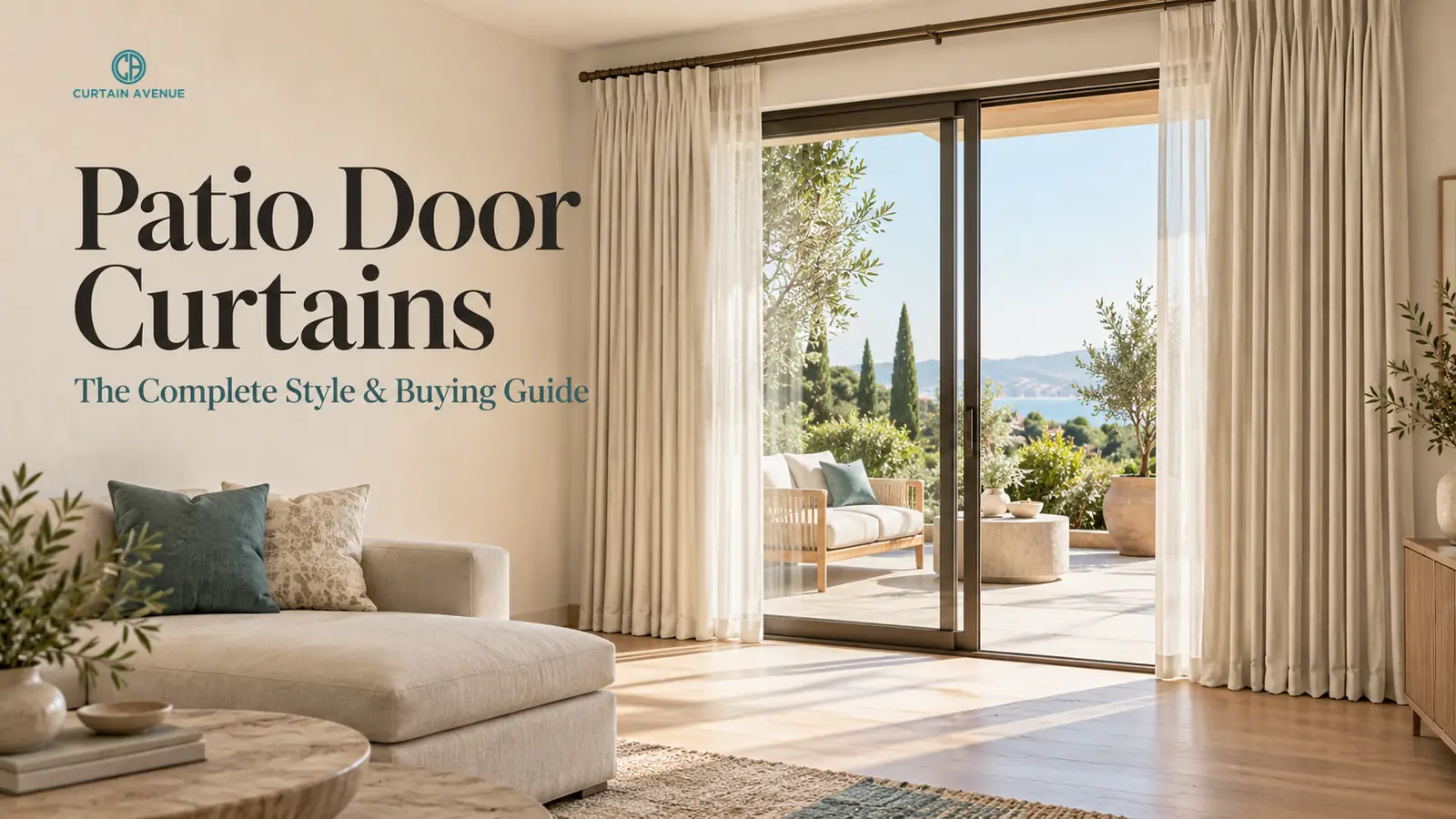
The right curtains for a patio door start with hardware, not fabric: choose a grommet or pinch-pleat header on rings — never a rod pocket, which bunches and snags on a track that opens and closes daily — size the panels to roughly twice the rod’s width for proper fullness, and mount the rod 4-6 inches above the frame so panels clear the door when it slides. Get those three right and almost any fabric or color works from there.
A patio door is a door first and a window second, and most curtain-buying advice treats it like the reverse. Here’s what actually changes when the “window” you’re dressing gets walked through several times a day.
Still deciding which window treatment is right for your door? Compare curtains, blinds, and shades for sliding glass doors before choosing.
A patio door curtain has to survive being pushed aside daily, which a curtain on a static window never has to do — that single fact is what should drive nearly every choice below, from header style to fabric weight. Rod pocket curtains, the single most common header style for regular windows, are the one style to actively avoid here: the fabric bunches directly on the rod with no rings or hardware to glide on, so it snags and drags every time the panel is pushed open. Grommet headers (metal rings sewn into the top of the panel) and pinch pleat headers on curtain rings both solve this the same way — smooth, low-friction gliding — while pinch pleat keeps a more tailored, formal look and grommet reads a bit more casual and modern.
What’s the best curtain heading style for a patio door? A standard center-open rod with a center support bracket works for most patio doors and lets panels split and stack to both sides; a one-way draw track is the better choice when you want the panels to stack fully to one side only, which maximizes the clear opening on a door you walk through constantly. The one-way setup is common on doors where furniture or a wall on one side rules out a two-panel, split-in-the-middle look, and it’s worth asking for by name — it’s a smaller, more specialized heading style category than a standard double rod, but it solves the “extreme width” problem wide patio doors create better than anything else.
For doors 8 feet wide or wider, a center support bracket isn’t optional on a standard rod — without one, a rod that long will bow under the weight of two full curtain panels.
Patio door curtain panels should total roughly twice the width of the rod they hang on, and hang about ½ inch to 1 inch above the floor so the hem clears the door’s track. For a rod around 100-110 inches (a typical fit for an 80-inch-wide patio door), that means combined panel width in the 200-220 inch range across both panels — skimping on fullness is what makes curtains look flat and cheap rather than tailored, regardless of how much you spend on the fabric itself. Because the rod typically mounts higher than a standard window rod, 96 or 108-inch panel lengths fit better than the standard 84-inch length most ready-made curtains come in.
A patio door’s glass is usually the single largest source of heat loss or gain in the room it’s in, which makes insulated or thermal-lined curtains one of the higher-impact upgrades you can make to it. A blackout or thermal lining traps a layer of air between the fabric and the glass, cutting both summer heat gain and winter draft the way an uninsulated single panel of fabric can’t. This matters more on a patio door than on a comparable window simply because of its size — more glass means more potential energy loss, and more curtain doing the insulating once it’s covered.
Do patio door curtains need to be blackout? Not necessarily, and for a door that’s the main daytime connection to a patio or backyard, full blackout can feel like overkill during the day. Layering a sheer or light-filtering panel for daytime privacy — enough to soften the “fishbowl” feeling of a fully glass wall without blocking the view outside — with a heavier blackout or thermal panel closed only at night is the most common way to get both. This is especially worth considering on a patio door facing a shared yard, a street, or close neighbors, where full-time coverage isn’t practical but full-time exposure isn’t comfortable either.
Not every patio door slides — French patio doors (a hinged pair that swings open) need a different curtain approach entirely, since each door panel moves independently and a curtain can’t span both without getting caught when one side opens. Mount a slim rod directly on each individual door panel rather than spanning the whole opening, and choose a lighter-weight, light-filtering fabric — a heavy blackout panel adds noticeable weight and drag to a door that has to swing on hinges rather than glide on a track. Café-style curtains covering just the lower half of each door panel are a common French-door-specific option that doesn’t exist for a sliding door at all, since French doors are typically half-glass with a solid lower panel already offering some privacy.
A patio door often gets more direct, sustained sun than a comparably sized interior window, especially on a south- or west-facing wall, which makes UV-resistant or fade-resistant fabric worth prioritizing here more than on other windows in the house. If the patio itself is a three-season room, sunroom, or otherwise less climate-controlled space, an indoor/outdoor-rated fabric — mildew- and moisture-resistant, without sacrificing the look of a standard curtain — holds up better than a fabric built purely for a fully conditioned interior.
What is the best header style for patio door curtains?
Grommet or pinch pleat on curtain rings — both glide smoothly over a rod with no friction, unlike rod pocket curtains, which bunch directly on the rod and snag when pushed aside on a door used daily.
How wide should curtains be for a patio door?
Aim for combined panel width of roughly twice the rod’s width — for a 100-110 inch rod, that’s 200-220 inches of fabric across both panels — so the panels stack back fully and look intentionally full rather than flat when the door is open.
Should patio door curtains be blackout?
Not necessarily. Layering a sheer or light-filtering panel for daytime privacy with a heavier blackout or thermal panel for nighttime is the most common approach, since it preserves the daytime view a fully glass patio door is usually there for in the first place.
Do I need special curtains for French patio doors?
Yes — mount a slim rod on each individual door panel rather than spanning the whole opening, and choose a lighter-weight fabric, since French doors swing on hinges and a heavy panel spanning both sides will catch or drag when one door opens independently of the other.
What is a one-way draw track and do I need one?
A one-way draw track pulls both curtain panels to stack fully on one side instead of splitting to both sides. It’s worth choosing over a standard center-open rod when furniture, a wall, or the room’s layout on one side rules out a two-panel, split-in-the-middle setup, or when you simply want the clearest possible opening on a door you use often.
Do patio door curtains need to be a special fabric because they’re near a door to the outside?
Not always, but a patio-facing door typically gets more direct sun than other windows, so a fade-resistant fabric is worth prioritizing. If the patio side is a sunroom, screened porch, or otherwise less climate-controlled, an indoor/outdoor-rated fabric holds up to moisture and humidity better than a standard indoor curtain fabric.
Patio door curtains come down to treating the door as a door first: pick a header that glides (grommet or pinch pleat, never rod pocket), size the hardware and fabric fullness for the width you’re actually working with, and choose insulation and privacy levels based on how the space is really used day to day. Get those fundamentals right and the style choices — fabric, color, French door vs. sliding — are the easy part.
Additional Resources
The Ultimate Guide to Patio Door Curtains — Three Girls
Patio Door Curtain Ideas — Family Handyman
Ready to get exact sizing for your own patio door? Start your custom curtains quote and enter your door’s measurements to see panel and hardware recommendations for your space.
Window treatment How it’s built How you control light Best for Venetian blinds Horizontal slats on ladders Tilt slats +
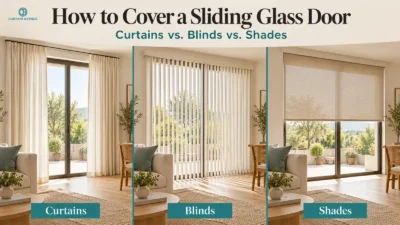
Factor Curtains Blinds Shades Light control Good in full draw; layering with sheers gives fine control Best — tilt slats
Our design experts are here to help you find the perfect fit for your home.